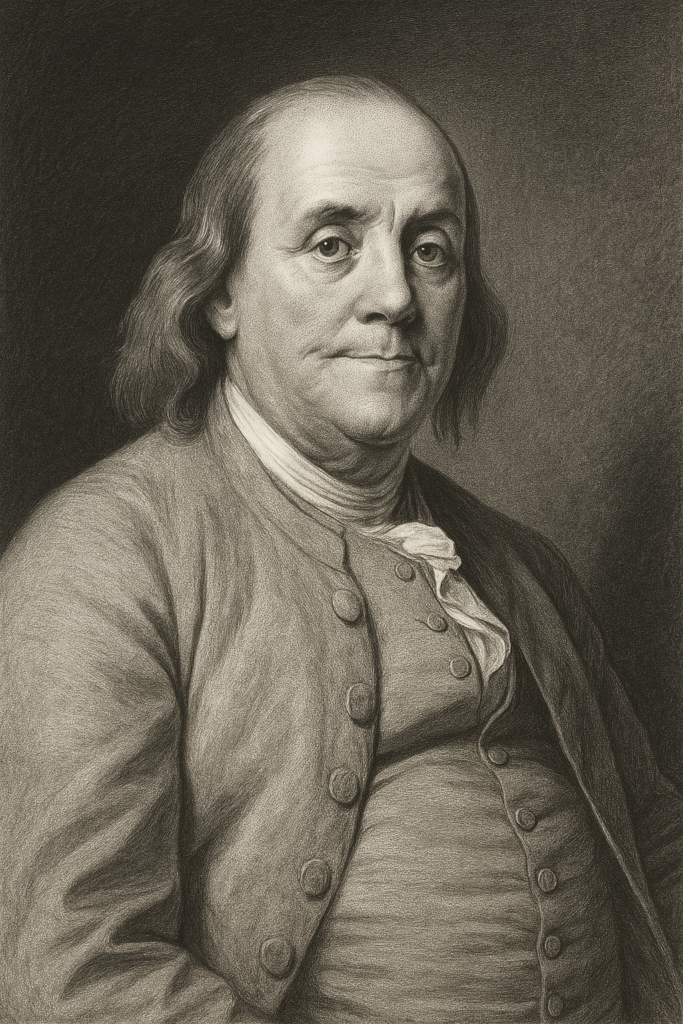
1. Introduction to Benjamin Franklin
Benjamin Franklin began life in Boston, navigating a humble upbringing which profoundly influenced his later pursuits. Subsequently, his father intended him for the clergy, but the young Franklin clearly gravitated toward books and writing. Therefore, he found a position as an apprentice to his older brother James, a printer, thereby starting his career in publishing. Moreover, this environment provided him with vital, self-directed learning because he voraciously read every book he could access. Consequently, this early immersion in literature and public discourse fueled his intellectual curiosity and established his lifelong dedication to self-improvement. Furthermore, he learned the printing trade thoroughly, mastering every facet of the business. Hence, he developed his sharp, practical intellect during these formative years. Thus, the foundation for his future status as a leading statesman and inventor was cemented through disciplined self-education. Indeed, his commitment to knowledge became a cornerstone of the emerging American ethos. Ultimately, this disciplined focus defined the man who shaped American identity.
2. Early Life and Education
Benjamin Franklin started his journey in Boston, receiving only two years of formal schooling, which severely limited his initial academic prospects. Consequently, he became an apprentice to his brother’s printing shop at a young age, actively compensating for his lack of formal education. Moreover, this environment allowed him access to a wealth of books, thereby facilitating his vital self-education. Therefore, he spent countless hours reading and practicing his writing skills, consciously adopting various literary styles. Furthermore, he created the persona of “Silence Dogood,” thus publishing satirical letters in his brother’s newspaper. Hence, he developed his critical voice and literary talent during these formative years. Thus, this early independence honed his intellect, securing the basis for his eventual rise. Indeed, his dedication to learning remains a powerful symbol of his ambition. Ultimately, his intellectual hunger defined his trajectory from tradesman to philosopher.
3. The Master Printer
Benjamin Franklin quickly emerged as a master printer, utilizing his intellect and keen business acumen to achieve great success in Philadelphia. Consequently, he purchased The Pennsylvania Gazette, which quickly became a highly influential and profitable colonial newspaper. Moreover, his publication of Poor Richard’s Almanack significantly boosted his reputation because it offered practical advice and witty maxims. Therefore, this almanac circulated widely throughout the colonies, thereby shaping colonial values regarding industry, thrift, and virtue. Furthermore, he developed a brilliant business model, opening printing partnerships in other colonies. Hence, his early financial independence secured his freedom to pursue public service. Thus, he used the power of the press to inform and unify the colonies. Indeed, his success demonstrated that hard work and ingenuity led to prosperity. Ultimately, the wealth and influence he gained from his trade underpinned his revolutionary career.
4. Publication of Poor Richard’s Almanack
The publication of Poor Richard’s Almanack cemented Benjamin Franklin’s image as a moralist and practical philosopher among the colonists. Consequently, he filled the annual publication with useful information, including calendars, weather predictions, and celestial data. Moreover, the almanac gained enormous popularity because it seasoned the pages with proverbs advocating thrift, industry, and virtue. Therefore, phrases like “A penny saved is a penny earned” entered the common lexicon, thereby instructing and entertaining the masses. Furthermore, the almanac’s wide circulation allowed him to shape colonial ethos on a broad scale, thus exerting significant cultural influence. Hence, his clever use of the pen established a common set of values. Thus, this literary success provided the foundational respect necessary for his political career. Indeed, the maxims remain famous today, demonstrating the lasting power of his wit. Ultimately, this publication secured his literary and financial independence.
5. Start of Public Service Career
Benjamin Franklin consciously retired from his printing trade at the young age of forty-two, actively signaling the start of his focus on public service and philosophy. Consequently, his financial independence allowed him to dedicate the rest of his life to civic improvement and intellectual pursuits. Moreover, he consciously decided to “devote what remains to the public good,” thereby aligning his actions with his stated virtues. Therefore, he immediately began organizing various community initiatives, recognizing his unique position to effect change. Furthermore, his administrative and organizational skills, honed in business, proved invaluable for large-scale civic projects. Hence, he transitioned seamlessly from a successful entrepreneur to a dedicated statesman. Thus, this calculated career shift demonstrated his commitment to the collective welfare. Indeed, his dedication to the community set a strong example for later generations. Ultimately, his early retirement allowed him to fulfill his enormous legacy.
6. Foundation of the Library Company
Benjamin Franklin established the Library Company of Philadelphia, a groundbreaking institution actively promoting literacy and intellectual access for all citizens. Consequently, he recognized that books were expensive and inaccessible to ordinary people, which limited the spread of knowledge. Moreover, he created a subscription model, whereby members paid a small annual fee, thereby allowing the sharing of intellectual resources. Therefore, this innovation established the first successful public lending library in America, acting as a model for future institutions. Furthermore, the library became a vital center for intellectual discourse, thus fostering an informed public sphere. Hence, his organizational ingenuity directly contributed to the Enlightenment ideals of the colonies. Thus, he provided the means for collective self-improvement for the American people. Indeed, the library remains a testament to his commitment to democratic learning. Ultimately, this civic achievement significantly boosted his reputation as a public benefactor.
7. Establishment of the First Fire Company
Benjamin Franklin organized the Union Fire Company of Philadelphia, establishing the first volunteer fire department in the American colonies. Consequently, he realized that devastating fires frequently destroyed city infrastructure and homes, which demanded a collective, organized response. Moreover, he actively recruited citizens committed to public safety, thereby instilling a sense of shared responsibility. Therefore, this initiative created a systematic approach to fire prevention and response, replacing chaotic, individual efforts. Furthermore, the company structure became a successful model replicated throughout the colonies, thus demonstrating his genius for civic organization. Hence, his practical reforms directly improved urban safety and quality of life. Thus, this project showcased his talent for turning observation into effective public action. Indeed, he demonstrated the importance of community effort for shared stability. Ultimately, this practical reform cemented his standing as a leading civic leader.
8. The Junto and Intellectual Societies
Benjamin Franklin founded “The Junto,” also known as the Leather Apron Club, which served as a crucial intellectual and mutual improvement society in Philadelphia. Consequently, he brought together ambitious young tradesmen and artisans, thereby creating a space for reasoned debate and shared knowledge. Moreover, members discussed moral, political, and philosophical questions, actively sharpening their critical thinking skills. Therefore, the Junto became a fertile ground for civic innovation, eventually spawning institutions like the Library Company and the fire company. Furthermore, the society fostered networking and mutual professional support, thus elevating its members’ social standing. Hence, this club promoted both individual virtue and collective action. Thus, he created a democratic forum for the exchange of ideas among the city’s emerging leaders. Indeed, the Junto perfectly embodied his belief in self-education and collaborative progress. Ultimately, this organization became the intellectual engine for much of his early civic legacy.
9. Discoveries in Electricity
Benjamin Franklin pursued scientific inquiry into electricity with relentless vigor, becoming an internationally renowned inventor and philosopher. Consequently, his famous experiments confirmed that lightning was electrical in nature, which fundamentally changed scientific understanding. Moreover, he introduced new terminology, including “positive,” “negative,” and “battery,” thereby providing a clearer language for electrical phenomena. Therefore, his work established the theory of electrical fluid conservation, paving the way for future electrical science. Furthermore, he actively conducted the famous kite experiment (though its details are often exaggerated), thus proving his theory about lightning. Hence, his work secured him the Copley Medal and widespread fame across Europe. Thus, he demonstrated that American ingenuity stood at the forefront of the Enlightenment. Indeed, his inquiries elevated him far beyond his humble origins. Ultimately, his electrical discoveries remain his most celebrated scientific achievement.
10. The Lightning Rod Invention
Benjamin Franklin applied his electrical science to practical use by inventing the lightning rod, a crucial safety device for colonial buildings. Consequently, he reasoned that if lightning was simply a form of static electricity, then a grounded metal rod could safely divert the charge. Moreover, this simple but brilliant invention protected countless buildings and ships from fire and destruction, thereby saving lives and property. Therefore, the lightning rod was widely adopted across the globe, showcasing the universal utility of his work. Furthermore, he famously refused to patent the invention, thus demonstrating his commitment to the public good and shared progress. Hence, his dedication to accessibility underscored his moral ethos. Thus, this practical ingenuity immediately benefited society. Indeed, the lightning rod became a powerful symbol of human control over nature. Ultimately, this invention cemented his reputation as a benevolent inventor.
11. Invention of Bifocal Glasses
Benjamin Franklin personally solved his own vision problems by inventing bifocal glasses, thus providing a practical solution for millions of people. Consequently, he grew tired of constantly switching between two pairs of spectacles (one for reading, one for distance), which proved cumbersome and inconvenient. Moreover, he realized he could cut the lenses in half and place them in a single frame, thereby allowing simultaneous near and far vision. Therefore, this simple but effective innovation immediately improved his daily life and productivity. Furthermore, the bifocal concept spread widely, thus establishing a standard in optometry. Hence, this invention showcased his constant search for practical improvements in daily living. Thus, his ingenuity arose directly from personal need. Indeed, the bifocals reflect his pragmatic, problem-solving approach to life. Ultimately, this remains one of his most widespread and useful personal inventions.
12. The Franklin Stove
Benjamin Franklin designed and invented the Franklin Stove, significantly improving home heating efficiency and safety throughout the colonies. Consequently, traditional open fireplaces wasted enormous amounts of heat up the chimney, which was inefficient and costly. Moreover, his cast-iron stove design used a clever air baffle system, thereby directing more heat into the room and conserving fuel. Therefore, the stove provided more effective and safer heating for colonial homes, especially during harsh winters. Furthermore, this invention became a popular household appliance, thus demonstrating the commercial viability of his ingenuity. Hence, he contributed directly to the domestic comfort of the American people. Thus, he consistently sought practical solutions that benefited the common citizen. Indeed, the stove symbolizes his dedication to practical science. Ultimately, this invention bolstered his image as a public benefactor.
13. Political Agent in London
Benjamin Franklin served as a political agent for several colonies in London, tirelessly advocating for American interests before the British Parliament and Crown. Consequently, he spent many years abroad, mastering the intricacies of European diplomacy and politics. Moreover, he consistently communicated the perspectives and grievances of the American people, thereby attempting to bridge the growing divide with Britain. Therefore, his reputation as a renowned scientist initially gave him easy access to powerful British officials. Furthermore, he often faced intense scrutiny and hostility, particularly after the Stamp Act crisis, thus testing his resilience. Hence, his experience in London provided an unparalleled view of British colonial policy. Thus, he spent years trying to maintain peace before the outbreak of the Revolution. Indeed, his dedication during this challenging period was crucial for the colonial cause. Ultimately, this period prepared him for his greatest diplomatic roles.
14. Opposing the Stamp Act
Benjamin played a crucial role in opposing the Stamp Act of 1765, actively leveraging his knowledge of British politics to aid the colonial cause. Consequently, he testified before the House of Commons, vigorously explaining the economic harm and constitutional offense the act inflicted upon the colonists. Moreover, his testimony was highly effective, providing clear and reasoned arguments against the legislation. Therefore, he demonstrated the deep resentment the act had sparked in the colonies, thereby influencing British opinion. Furthermore, his arguments helped secure the repeal of the Stamp Act, thus scoring a major early victory for the American people. Hence, his public advocacy solidified his reputation as a staunch defender of American rights. Thus, he proved his worth as a key colonial representative abroad. Indeed, this political confrontation sharpened his dedication to the cause of liberty. Ultimately, this episode was a turning point in his early political career.
15. The Hutchinson Letters Affair
Benjamin became embroiled in the Hutchinson Letters Affair, a major political scandal that significantly escalated tensions between Britain and the American colonies. Consequently, he secretly obtained letters from Massachusetts Governor Thomas Hutchinson, which revealed the Governor’s request for tighter control over the colonists. Moreover, he sent these letters to Boston, where their publication inflamed public opinion against the royal authorities. Therefore, his role was eventually exposed, leading to his public humiliation and dismissal from his Postmaster General position. Furthermore, this event marked a final, irreparable break with the British government, thus signaling his transition to an open revolutionary. Hence, he sacrificed his career for the cause of liberty. Thus, this act of calculated treason cemented his revolutionary identity. Indeed, the affair showed his willingness to engage in high-stakes politics. Ultimately, this incident forced his final return to America.
16. Return to America and Revolutionary Fervor
Benjamin returned to Philadelphia in 1775, finding a nation on the brink of war, and immediately plunged into the revolutionary movement. Consequently, he had spent nearly two decades abroad, which had given him a unique perspective on the burgeoning conflict. Moreover, he quickly became a delegate to the Second Continental Congress, thereby lending his immense experience and prestige to the cause. Therefore, his return symbolized the commitment of the American intelligentsia to the fight for liberty. Furthermore, he served on several key committees, thus helping to manage the logistical and political challenges of the nascent revolution. Hence, his presence instantly bolstered the morale of the younger revolutionaries. Thus, he used his last years to secure the very existence of the American republic. Indeed, his return marked the final, crucial chapter of his life. Ultimately, he embraced his new role as a devoted Founding Father.
17. Drafting the Declaration of Independence
Benjamin played a key role in drafting the Declaration of Independence, lending his wisdom and editorial skill to the crucial document. Consequently, he was a member of the Committee of Five, along with Thomas Jefferson, John Adams, Roger Sherman, and Robert Livingston. Moreover, he famously offered several minor, but crucial, editorial suggestions to Jefferson’s initial draft, thereby improving the document’s flow and clarity. Therefore, his presence on the committee lent enormous political weight and authority to the Declaration’s adoption. Furthermore, he stood firmly behind the principles of liberty and equality articulated within the text, thus risking his life and legacy. Hence, he formally asserted the colonies’ right to self-governance. Thus, he contributed directly to the very founding statement of the American republic. Indeed, his signature is one of the most recognized on the final document. Ultimately, his input ensured the text spoke clearly to the American people.
18. The Second Continental Congress
Benjamin served as an indispensable member of the Second Continental Congress, contributing his unparalleled statesmanship to the body that governed the nation during the war. Consequently, he served on numerous crucial committees, including those related to foreign affairs, finance, and the military. Moreover, his administrative talent and calm demeanor proved invaluable for organizing the fledgling war effort, thereby providing much-needed stability. Therefore, he helped establish the American postal system, recognizing its vital role in communication and troop movement. Furthermore, his authority and experience gave legitimacy to the Congress, thus silencing many domestic critics. Hence, he actively managed the complex politics of the revolutionary era. Thus, he provided the operational backbone for the revolutionary government. Indeed, his work ensured the Congress functioned effectively during a national crisis. Ultimately, his efforts secured the necessary infrastructure for the revolution’s survival.
19. Diplomat to France
Benjamin Franklin undertook his greatest diplomatic mission as the representative to France, securing the crucial foreign alliance needed for American victory. Consequently, he arrived in Paris in 1776, already possessing immense fame as a scientist and philosopher. Moreover, his carefully cultivated persona—simple clothing and intellectual wit—charmed the French public and elite, thereby making him a diplomatic sensation. Therefore, he skillfully navigated the complex French court and political landscape, securing vital loans and military aid. Furthermore, his primary goal was obtaining France’s formal entry into the war against Britain, thus turning a colonial revolt into a global conflict. Hence, his charm became the most powerful tool in the American arsenal. Thus, he essentially managed the financial and military future of the American republic. Indeed, his French mission remains the pinnacle of American diplomacy. Ultimately, he secured the support that guaranteed American victory.
20. Securing the Franco-American Alliance
Benjamin successfully negotiated the Franco-American Alliance of 1778, which became the single most important diplomatic achievement of the Revolution. Consequently, this treaty secured France’s recognition of American independence, which legitimized the revolutionary government on the world stage. Moreover, the alliance provided vital military support, including French troops and naval power, thereby neutralizing Britain’s naval superiority. Therefore, it also secured essential financial loans and supplies, which kept the Continental Army operational throughout the war. Furthermore, his tireless negotiation and strategic patience were key to overcoming French hesitation, thus ensuring the treaty’s signing. Hence, this alliance turned the tide of the war decisively in America’s favor. Thus, he proved an indispensable statesman whose work saved the American people. Indeed, the alliance represents his highest achievement in foreign politics. Ultimately, this treaty guaranteed the birth of the republic.
21. The Treaty of Paris (1783)
Benjamin served as a key negotiator for the Treaty of Paris in 1783, which formally ended the Revolutionary War and secured the boundaries of the new republic. Consequently, he, along with John Adams and John Jay, expertly navigated complex European politics and the competing interests of Britain, France, and Spain. Moreover, his primary goal was securing the best possible terms for the American people, including vast western territories. Therefore, his steady demeanor and diplomatic skill proved instrumental in concluding the agreement successfully. Furthermore, the treaty formally recognized American independence and established its borders up to the Mississippi River, thus guaranteeing its future expansion. Hence, he ensured that the military victory translated into a lasting political settlement. Thus, he successfully oversaw the final, formal act of the Revolution. Indeed, the treaty stands as a monument to his final diplomatic success. Ultimately, he secured America’s future as a continental power.
22. Postmaster General Role
Benjamin held the position of Postmaster General for the American colonies, demonstrating his practical ingenuity and organizational genius in colonial administration. Consequently, he greatly improved the efficiency and speed of the colonial postal system, which facilitated vital communication across the vast territories. Moreover, he pioneered techniques like establishing accurate routes and standardized rates, thereby creating a reliable infrastructure. Therefore, his experience in this role provided him with unparalleled knowledge of colonial geography and communication needs, which later aided the revolution. Furthermore, he was temporarily dismissed from the British post after the Hutchinson Letters Affair, thus highlighting his early revolutionary sympathies. Hence, he understood the logistical needs of the American people. Thus, his administrative skills were applied directly to critical public service. Indeed, his work laid the groundwork for the modern postal service. Ultimately, his contributions to communication were essential for colonial unity.
23. Role in the Constitutional Convention
Benjamin served as the oldest delegate at the Constitutional Convention in 1787, lending his immense prestige and calming influence to the crucial proceedings. Consequently, his presence provided legitimacy and a direct link to the Declaration of Independence generation, which was vital for the convention’s authority. Moreover, he often acted as a mediator between strongly opposed factions, particularly between large and small states, thereby encouraging compromise. Therefore, his wit and wisdom frequently eased tensions when debates became acrimonious, preventing the collapse of the negotiations. Furthermore, he gave a powerful final speech urging unanimous acceptance of the Constitution, thus ensuring its successful adoption. Hence, he demonstrated his final act of statesmanship in shaping the American republic. Thus, his support was instrumental in creating the new federal government. Indeed, his contributions secured his place as a revered Founding Father. Ultimately, his counsel ensured the viability of the new political system.
24. Advocacy for Compromise and Union
Benjamin passionately advocated for compromise and union during the contentious debates of the Constitutional Convention, recognizing the fragile nature of the new republic. Consequently, he famously proposed the “Great Compromise,” which established a bicameral legislature, balancing representation based on population and state equality. Moreover, he understood that ideological purity risked the entire project, thereby prioritizing the creation of a functional government above all else. Therefore, he urged delegates to overlook their minor personal objections and sign the Constitution for the sake of the nation’s future. Furthermore, his lifelong experience in politics taught him the necessity of negotiation and mutual concession, thus guiding his actions. Hence, he consistently championed a strong central authority. Thus, his dedication to national unity preserved the gains of the Revolution. Indeed, his call for compromise remains a classic moment in American statesmanship. Ultimately, his wisdom secured the final structure of the Constitution.
25. Philosophical Self-Improvement
Benjamin rigorously pursued philosophical self-improvement, actively charting his progress toward achieving moral perfection throughout his adult life. Consequently, he famously created a list of thirteen virtues, including Temperance, Silence, and Industry, which served as a guide for his conduct. Moreover, he developed a systematic daily plan to focus on one virtue each week, thereby applying a pragmatic, scientific approach to morality. Therefore, he believed that disciplined self-monitoring was essential for personal happiness and public utility. Furthermore, this focus on moral discipline became a central element of the developing American ethos, thus inspiring countless citizens. Hence, he viewed the pursuit of virtue as a continuous, lifelong project. Thus, his emphasis on character development profoundly shaped his personal legacy. Indeed, his system became famous through his autobiography. Ultimately, his moral system defined the self-made man ideal.
26. The American Ethos of Industry and Thrift
Benjamin fundamentally shaped the American ethos by championing the values of industry and thrift, actively promoting them through his writings and personal example. Consequently, he believed that hard work and fiscal prudence were the surest paths to financial success and moral uprightness. Moreover, his maxims, like “Early to bed and early to rise, makes a man healthy, wealthy, and wise,” became guiding principles for colonial citizens. Therefore, he demonstrated that these qualities, not inherited wealth or status, determined one’s place in society. Furthermore, his own rise from a poor trade apprentice to a wealthy philosopher provided a powerful, living example of his philosophy. Hence, he made hard work a source of national pride. Thus, his pragmatic virtues became foundational to the national identity. Indeed, his philosophy fueled the spirit of capitalism in America. Ultimately, his economic worldview remains deeply ingrained in the American people.
27. Views on Education and Knowledge
Benjamin maintained a passionate commitment to education and the widespread dissemination of knowledge, viewing it as the bedrock of a successful republic. Consequently, he tirelessly advocated for accessible learning, leading him to found the Library Company and the University of Pennsylvania. Moreover, he believed that an informed citizenry was essential for a functioning democracy, thereby promoting literacy among the American people. Therefore, his focus on practical and useful knowledge contrasted with the purely classical curricula of older European universities. Furthermore, he believed that science and practical ingenuity should be taught alongside the humanities, thus reflecting his own broad intellectual interests. Hence, his educational philosophy prioritized utility and civic engagement. Thus, he ensured that future generations possessed the tools for self-governance. Indeed, his dedication to learning defined his entire intellectual legacy. Ultimately, he sought to create a more enlightened, capable public.
28. Founding the University of Pennsylvania
Benjamin spearheaded the effort to found the University of Pennsylvania (originally the Academy and College of Philadelphia), establishing a vital new model for higher education. Consequently, he aimed to create an institution with a curriculum more practical and useful than older colonial colleges like Harvard. Moreover, the university focused on subjects like science, modern languages, and trade, thereby preparing students for civic and commercial leadership. Therefore, his vision was deeply democratic, aiming to train future leaders from a broader cross-section of society. Furthermore, the establishment of the university underscored his belief that education was critical to the long-term success of the American republic. Hence, he ensured the perpetuation of enlightened thought. Thus, the institution remains a lasting testament to his commitment to public welfare. Indeed, the university symbolizes his faith in the potential of the American people. Ultimately, he provided a crucial intellectual infrastructure for the new nation.
29. Experiments in Meteorology and Oceanography
Benjamin Franklin expanded his scientific inquiries beyond electricity, making significant, though often overlooked, contributions to meteorology and oceanography. Consequently, he was the first to accurately map the Gulf Stream, documenting the warm, powerful current in the North Atlantic. Moreover, he used this knowledge to advise American ship captains on faster transatlantic routes, thereby improving trade and communication. Therefore, he also proposed theories on the movement of storms and the transmission of cold fronts, challenging existing European weather models. Furthermore, his observations demonstrated his meticulous approach to all fields of science, thus showcasing his versatility as a philosopher. Hence, he consistently applied his intellect to practical problems. Thus, his non-electrical research proved his immense intellectual range. Indeed, his work helped reduce travel time between the continents. Ultimately, his research secured his international scientific reputation.
30. The Grand Plan of Union (Albany Plan)
Benjamin first proposed the Albany Plan of Union in 1754, actively articulating an early vision for colonial unity and cooperative government. Consequently, he recognized the colonies needed a unified defense system during the French and Indian War, which demanded a central governing council. Moreover, the plan called for a general government that would manage military affairs, trade, and westward expansion, thereby creating a stronger political entity. Therefore, though the plan was ultimately rejected by the individual colonial assemblies, it laid the intellectual groundwork for later national unity. Furthermore, his early advocacy for union demonstrated his far-sighted statesmanship and dedication to the future republic. Hence, he proved his commitment to collective action over narrow local interests. Thus, this early attempt at federalism foreshadowed the eventual Constitution. Indeed, the Albany Plan remains a key milestone in American political history. Ultimately, his vision preceded the actual creation of the American identity.
31. Views on the American Colonies
Benjamin viewed the American colonies not as separate entities but as a cohesive geographical and political unit capable of self-governance and economic prosperity. Consequently, his tireless work as a political agent for several colonies underscored his belief in their shared destiny and interests. Moreover, he recognized the unique democratic ethos and economic potential of the American people, which contrasted sharply with European societies. Therefore, he consistently promoted inter-colonial cooperation and unity, seeing it as essential for resisting British authority. Furthermore, his early proposals for union, like the Albany Plan, demonstrated his conviction that the colonies needed a strong central government. Hence, he fostered a unified colonial identity long before the formal Declaration. Thus, his perspective moved beyond provincial concerns to a national vision. Indeed, his worldview was indispensable to the success of the Revolution. Ultimately, he nurtured the idea of a distinct American nation.
32. The Art of Negotiation and Diplomacy
Benjamin Franklin excelled in the art of negotiation and diplomacy, utilizing his wit, charm, and strategic patience to achieve complex political goals. Consequently, his enormous international reputation as a scientist often opened doors that traditional diplomats could not access. Moreover, he masterfully played on the rivalries between European powers, particularly France and Britain, thereby securing maximum leverage for the American cause. Therefore, his simple dress and unpretentious manner contrasted sharply with the formality of European courts, earning him public adoration. Furthermore, his ability to patiently manage long, difficult negotiations, such as those for the Treaty of Paris, proved his invaluable statesmanship. Hence, he consistently achieved American objectives through subtlety and intellect. Thus, his diplomatic skill secured the survival of the American republic. Indeed, he remains the gold standard for American foreign politics. Ultimately, his charm was his most effective diplomatic tool.
33. His Role as a Cultural Icon
Benjamin Franklin achieved the status of a true cultural icon both in America and Europe, representing the Enlightenment ideals of reason and practical ingenuity. Consequently, his image and writings were widely disseminated, making him the first globally recognized American celebrity. Moreover, his life story—the successful, self-made man—embodied the nascent American Dream, thereby providing a powerful narrative of opportunity. Therefore, his simple clothes and approachable persona in France cemented his image as the natural philosopher and virtuous statesman. Furthermore, his maxims and philosophical writings influenced common thought and ethos throughout the Western world, thus ensuring his cultural relevance. Hence, he was consciously viewed as a folk hero and intellectual giant. Thus, his persona became a symbol of the American identity. Indeed, his fame preceded the fame of the nation itself. Ultimately, his enduring image is one of wisdom and virtue.
34. Abolitionist Advocacy in Later Life
Benjamin underwent a profound moral transformation in his later life, becoming a passionate abolitionist and a leading voice against slavery. Consequently, he had previously owned slaves, but his moral conscience and Enlightenment principles eventually compelled him to condemn the practice. Moreover, he freed his own slaves and publicly advocated for the humane treatment and education of African Americans. Therefore, he became the President of the Pennsylvania Society for Promoting the Abolition of Slavery, using his prestige for this crucial moral cause. Furthermore, he submitted a final, bold petition to Congress advocating for the abolition of slavery just months before his death, thus challenging the nation’s hypocrisy. Hence, his final public acts cemented his reputation as a champion of human rights. Thus, his late-life virtue stands as a powerful moral statement. Indeed, his dedication provided an important legacy for the future. Ultimately, his moral evolution remains a compelling part of his story.
35. Financial Ingenuity and Wealth
Benjamin demonstrated remarkable financial ingenuity throughout his life, successfully building his fortune from a poor trade apprentice to one of the wealthiest men in Philadelphia. Consequently, he mastered the art of printing and leveraged the partnership model to expand his business holdings throughout the colonies. Moreover, his publication of Poor Richard’s Almanack became a highly profitable venture, thereby securing his early retirement. Therefore, he made calculated investments and championed prudent fiscal management, both personally and publicly. Furthermore, his financial independence allowed him the freedom to dedicate his later years entirely to science and politics, thus reinforcing his commitment to public service. Hence, his economic success validated his own maxims of industry and thrift. Thus, he became the primary model of the financially astute American. Indeed, his business practices were revolutionary in their simplicity. Ultimately, his wealth fueled his political and scientific career.
36. Contribution to American Journalism
Benjamin Franklin made indelible contributions to American journalism, elevating the press from simple trade to a powerful tool for political discourse and civic education. Consequently, his ownership and management of The Pennsylvania Gazette set a new standard for colonial newspapers through its editorial quality and wider coverage. Moreover, he pioneered the use of satire and political cartoons, thereby engaging the public in complex issues more effectively. Therefore, his early persona, “Silence Dogood,” demonstrated the power of a pseudonymous voice to influence public opinion and social norms. Furthermore, he understood the press’s vital role in unifying the disparate colonies, thus fostering a shared American identity. Hence, he instilled a sense of responsibility and purpose in the profession. Thus, his work ensured a free and vibrant press became central to the republic. Indeed, his journalistic legacy remains foundational today. Ultimately, he understood the true power of printed words.
37. Legacy in Science and Invention
Benjamin Franklin’s legacy in science and invention remains monumental, demonstrating that the American colonies could produce world-class philosophers and innovators. Consequently, his breakthroughs in electricity, notably the lightning rod, provided immense practical benefit and fundamentally advanced global knowledge. Moreover, his inventions like the bifocals and the Franklin Stove directly improved the daily lives of countless people, thereby blending theory with utility. Therefore, he approached scientific inquiry with a practical, accessible methodology, thus ensuring his discoveries were widely adopted. Furthermore, his scientific reputation granted him unique diplomatic access in Europe, thus aiding the Revolution. Hence, he proved the value of applied science for public welfare. Thus, his work secured the respect of European intellectual elites. Indeed, his ingenuity continues to define American innovation. Ultimately, his contributions transcended political boundaries.
38. Enduring Wisdom and Maxims
Benjamin Franklin’s enduring wisdom resides in his vast collection of maxims and aphorisms, which continue to influence popular culture and the American ethos. Consequently, his witty, pragmatic sayings encapsulated complex moral and financial advice into easily digestible forms, ensuring their wide dispersal. Moreover, Poor Richard’s Almanack served as the primary vehicle for this wisdom, thereby teaching generations about the importance of virtue, punctuality, and industry. Therefore, his maxims reinforced a cultural emphasis on self-reliance and personal responsibility. Furthermore, his practical philosophy valued utility and worldly success alongside moral rectitude, thus appealing to the entrepreneurial spirit. Hence, his writings remain a vital source of cultural instruction. Thus, he successfully imparted a set of core values to the American people. Indeed, his practical advice forms a significant part of his legacy. Ultimately, his words defined the pursuit of the American Dream.
39. The Quintessential American
Benjamin Franklin became the quintessential American, representing the very best of the nation’s democratic ideals, ingenuity, and intellectual spirit. Consequently, he embodied the journey from humble beginnings to global prominence entirely through hard work and self-education, which is the core of the American Dream. Moreover, his versatility as a printer, scientist, inventor, and statesman showcased the boundless potential of the free individual. Therefore, he blended Enlightenment rationalism with pragmatic American action, creating a unique and appealing identity. Furthermore, his dedication to civic improvement and public service set the standard for democratic citizenship, thus ensuring his moral authority. Hence, he remains a powerful, universally recognized national symbol. Thus, his life provides a blueprint for the American ethos. Indeed, he is the most well-rounded and versatile Founding Father. Ultimately, his multifaceted career permanently shaped the American character.
40. BENJAMIN FRANKLIN: The Man Who Shaped American Identity
Benjamin Franklin left an enormous and multi-faceted legacy, forever shaping the course of American history and identity. Consequently, his contributions as a printer, inventor, scientist, diplomat, and Founding Father established him as the most versatile figure of his era. Moreover, his emphasis on virtue, practicality, and self-reliance fundamentally defined the American character. Therefore, the institutions he founded continue to thrive, which demonstrates the enduring wisdom of his civic vision. Furthermore, his pragmatic approach to politics and compromise remains a model for effective statesmanship. Hence, his face on the hundred-dollar bill symbolizes the national value placed on his ingenuity and financial philosophy. Thus, his life story remains a compelling narrative of social mobility and intellectual achievement. Indeed, he essentially provided the template for the modern American identity. Subsequently, he remains a powerful, universally recognized symbol. Ultimately, Benjamin Franklin is rightfully considered one of the indispensable architects of the American republic.
The Friar in The General Prologue: https://englishlitnotes.com/2025/05/24/the-friar-in-the-general-prologue/
Articles: https://grammarpuzzlesolved.englishlitnotes.com/use-of-article/
Application for Remission of Fine: https://englishwithnaeemullahbutt.com/2025/05/20/application-remission-of-fine/
Willian Cullan Bryant’s Contribution to American Literature:
https://americanlit.englishlitnotes.com/william-cullen-bryant-contribution/
Discover more from Welcome to My Site of American Literature
Subscribe to get the latest posts sent to your email.