Introduction
Anne Bradstreet stands as America’s first significant published poet. She wrote with intellectual courage, personal honesty, and remarkable lyric beauty. Her works reflect the Puritan world she inhabited with deep conviction. Yet they also speak with extraordinary intimacy to every human heart. A Letter to Her Husband by Anne Bradstreet stands among her most beloved and widely studied poems. It expresses the aching longing of a wife separated from her husband by his public duties. Furthermore, it uses cosmic imagery of the sun, seasons, and elements to describe love’s absence. Consequently, the poem elevates personal domestic emotion into a universal poetic statement. Additionally, it connects naturally to her broader literary achievement. Her Contemplations showed her capacity for sustained nature meditation. Her Vanity of All Worldly Things revealed her theological depth and spiritual honesty. Therefore, this deeply personal love poem reveals yet another essential dimension. It proves that Bradstreet was as gifted in lyric intimacy as in philosophical argument.
1. Anne Bradstreet: Life, Marriage, and Colonial Context
Anne Bradstreet was born around 1612 in Northampton, England. She arrived in the Massachusetts Bay Colony in 1630 with her Puritan family. Furthermore, she married Simon Bradstreet at the remarkable age of sixteen. Consequently, their marriage became the emotional center of her personal and poetic life. Simon Bradstreet was a colonial administrator of considerable distinction and authority. Furthermore, he served in numerous public capacities that required frequent and extended absence. Consequently, Anne was regularly left alone to manage the household and raise their children. She bore eight children while suffering recurring serious illness. Therefore, Simon’s absences were not merely emotionally painful but practically demanding. Moreover, colonial Massachusetts was a demanding and sometimes dangerous environment. Anne managed the household, faced illness, and raised children without her husband’s support. Furthermore, she channeled these painful absences into extraordinary personal poetry. Additionally, her background gave her the classical and literary resources to express her feelings beautifully.
2. Simon Bradstreet: The Beloved Husband
Simon Bradstreet was a man of genuine distinction and colonial importance. He served the Massachusetts Bay Colony in numerous official and diplomatic capacities. Furthermore, he eventually became the Governor of the Massachusetts Bay Colony. Consequently, his public duties frequently demanded extended periods away from home. He was educated at Emmanuel College, Cambridge, a Puritan intellectual stronghold. Therefore, he and Anne shared a deeply literate and intellectually serious marriage. Moreover, their marriage combined genuine romantic love with Puritan spiritual commitment. Puritan marriages were not merely practical arrangements but genuine spiritual partnerships. Furthermore, Simon clearly admired and respected Anne’s extraordinary intellectual and poetic gifts. Additionally, his public service gave Anne’s personal poems their specific biographical context. Consequently, the absent husband of the poem was not a fictional construct. He was a real, beloved, and deeply missed presence in her life. Furthermore, understanding Simon’s public role illuminates the poem’s title directly. The phrase “absent upon public employment” referred specifically to his official colonial duties.
3. Overview of A Letter to Her Husband, Absent upon Public Employment
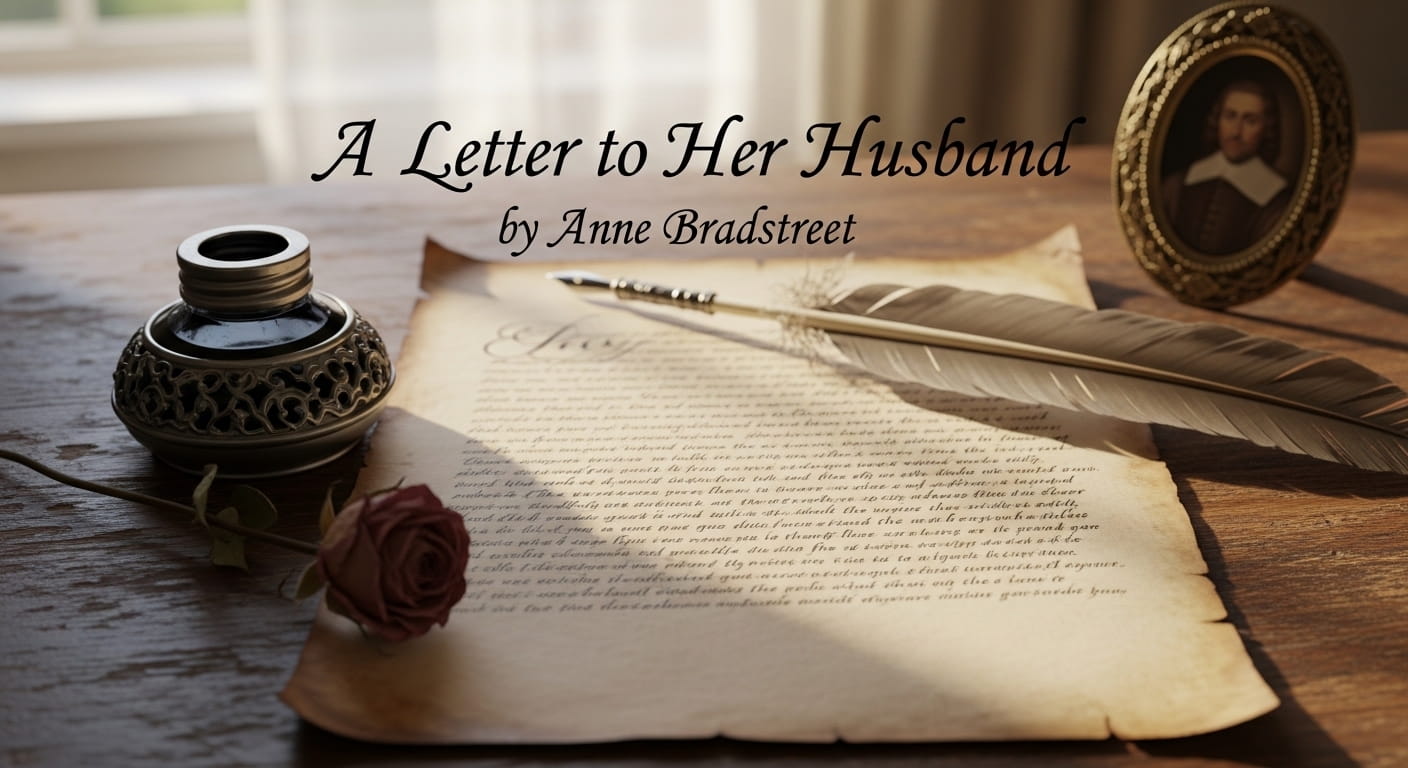
A Letter to Her Husband, Absent upon Public Employment is a lyric poem of remarkable emotional intensity. It uses the conceit of the husband as the speaker’s sun throughout. Furthermore, the sun’s absence from the speaker’s hemisphere mirrors the husband’s absence from her life. Consequently, the cosmic conceit elevates personal longing into a universal poetic statement. Additionally, the poem draws from the classical tradition of the Petrarchan love conceit. Bradstreet adapts this convention to her own specific Puritan colonial situation. Therefore, A Letter to Her Husband by Anne Bradstreet demonstrates her sophisticated literary knowledge and creative independence. Moreover, the poem moves through several emotional stages with great skill. First, the speaker establishes the cosmic identification of husband and sun. Then she meditates on the cold and darkness his absence creates. Furthermore, she considers the children they share as living tokens of their love. Additionally, she expresses her urgent longing for his return with passionate directness.
4. The Sun Conceit: Husband as Cosmic Force
The poem’s central and most brilliant device is the identification of the husband with the sun. Bradstreet establishes this cosmic conceit with elegant and confident precision. Furthermore, the sun was the most powerful natural symbol available in her literary tradition. Consequently, identifying Simon with the sun elevated their love to cosmic significance. Additionally, the conceit worked on multiple levels simultaneously. The sun provides light, warmth, and life to everything within its sphere. Therefore, the husband provides the same vital gifts to the speaker’s emotional world. Moreover, the sun’s daily movement from one hemisphere to another mirrors Simon’s departure. He has traveled to the other side of her emotional world. Furthermore, his absence leaves her hemisphere cold, dark, and spiritually diminished. Additionally, the sun conceit connects to Contemplations directly. In that poem, Bradstreet also meditates on the sun as a symbol of divine glory. Consequently, the sun carries both personal and theological significance in her poetic world.
5. Seasonal and Elemental Imagery
The poem uses seasonal and elemental imagery with sustained poetic richness. The husband’s presence represents summer, warmth, and abundant natural vitality. Furthermore, his absence transforms the speaker’s world into a cold and barren winter. Consequently, the seasonal contrast mirrors the emotional contrast between presence and absence. Additionally, the four seasons carry deeper literary and classical resonances. Bradstreet was deeply familiar with the classical tradition of seasonal symbolism. Therefore, her use of seasons was both personally expressive and literarily sophisticated. Moreover, the elemental imagery reinforces the seasonal pattern throughout the poem. Cold and warmth, light and darkness, vitality and desolation alternate with each other. Furthermore, these contrasts create the poem’s distinctive emotional rhythm. Additionally, the seasonal imagery connects to her Four Seasons poem directly. In that poem, she explored seasonal symbolism as a metaphor for human life stages. Consequently, the seasonal imagery in this poem participates in a consistent poetic vision.
6. The Petrarchan Tradition and Bradstreet’s Adaptation
A Letter to Her Husband by Anne Bradstreet participates in the Petrarchan tradition of love poetry. Petrarch established the dominant conventions of European love poetry in the fourteenth century. Furthermore, his influence shaped English Renaissance love poetry profoundly. Consequently, Bradstreet wrote within a well-established and highly prestigious literary tradition. Additionally, the Petrarchan tradition favored extravagant conceits celebrating the beloved’s qualities. The beloved’s eyes were like suns, her skin like snow, her lips like roses. Therefore, Bradstreet’s identification of Simon with the actual sun was a Petrarchan gesture. Moreover, she adapted this tradition with significant creative independence. The Petrarchan tradition typically featured a male poet celebrating an unattainable female beloved. Furthermore, Bradstreet reversed this conventional dynamic entirely and powerfully. She was a married woman celebrating a real and present husband with genuine love. Additionally, the love she expressed was mutual, reciprocal, and spiritually grounded in Puritan marriage. Consequently, her adaptation of Petrarchan convention was simultaneously traditional and radically personal.
7. Puritan Marriage and Romantic Love
The poem reflects the Puritan theology and practice of marriage with remarkable warmth. Puritanism held a high and genuinely positive view of marriage. Furthermore, it rejected the Catholic tradition that valued celibacy above matrimony. Consequently, Puritan marriage was a genuine spiritual vocation and sacred covenant. Additionally, husband and wife were spiritual companions and helpmates in the fullest sense. The love between spouses reflected and pointed toward God’s love for humanity. Therefore, Bradstreet’s passionate love for Simon was theologically sanctioned and encouraged. Moreover, the poem demonstrates that Puritan love could be genuinely romantic and passionately felt. The Puritan heart was not cold or repressed but genuinely capable of deep romantic feeling. Furthermore, Bradstreet expressed that feeling with complete honesty and literary grace. Additionally, the poem’s passionate tone challenges stereotypes about Puritan emotional life. Consequently, A Letter to Her Husband by Anne Bradstreet is important cultural evidence. It proves that Puritan men and women loved each other with genuine romantic passion.
8. The Feminist Dimensions of the Poem
The poem carries significant feminist dimensions worth careful examination. A Letter to Her Husband by Anne Bradstreet was written by a woman expressing desire and longing openly. Furthermore, women were not typically expected to express romantic desire publicly in her era. Consequently, her open expression of longing was itself a form of cultural transgression. Additionally, the poem asserts the equal emotional and spiritual needs of the wife. She is not merely a domestic support system but a full emotional being. Therefore, the poem implicitly argues for women’s capacity for deep romantic experience. Moreover, the poem challenges the asymmetry of public and private life. Simon’s life extended into the public world of colonial administration and politics. Furthermore, Anne’s life was confined largely to the private world of home and family. Additionally, the poem bridges this asymmetry through poetry itself. She entered the public literary world with her private emotional experience. Furthermore, this feminist dimension connects to her The Prologue directly.
9. The Children as Tokens of Love
The poem’s treatment of the couple’s children is one of its most moving dimensions. Bradstreet describes the children as living tokens and monuments of their shared love. Furthermore, the children embody the physical and spiritual union of husband and wife. Consequently, they become consoling presences during the period of Simon’s absence. Additionally, the children connect to the poem’s broader meditation on love’s endurance. Love does not disappear during absence but produces lasting fruit and testimony. Therefore, the children represent love’s tangible persistence through time and separation. Moreover, this treatment of children reflects Bradstreet’s broader poetic sensibility. She consistently found spiritual and emotional meaning in domestic experience. Furthermore, she transformed the ordinary details of colonial family life into genuine poetry. Additionally, the children’s presence gives the poem a distinctly feminine and maternal perspective. Bradstreet writes as both wife and mother with complete emotional authority. Consequently, A Letter to Her Husband by Anne Bradstreet captures the full complexity of a colonial woman’s emotional life.
10. Structure, Form, and Poetic Craft
The poem uses a carefully controlled formal structure throughout. A Letter to Her Husband, Absent upon Public Employment employs heroic couplets as its primary formal unit. Furthermore, the regular rhyme scheme gives the meditation a dignified and flowing movement. Consequently, form and content work together with satisfying aesthetic precision. Additionally, the poem’s letter format creates a distinctive and intimate rhetorical situation. The speaker addresses Simon directly as in a genuine private correspondence. Therefore, A Letter to Her Husband by Anne Bradstreet achieves a conversational intimacy unusual in formal verse. Moreover, the couplet form was the dominant mode of serious seventeenth-century English verse. Bradstreet employs it with natural ease and lyric grace. Furthermore, the poem’s moderate length suits its single sustained emotional subject. Additionally, the formal structure contains and disciplines the poem’s passionate emotional content. Consequently, the tension between formal control and passionate feeling creates the poem’s distinctive energy. Furthermore, Bradstreet’s mastery of the couplet demonstrates her technical accomplishment.
11. Language, Imagery, and Diction
Bradstreet’s language in this poem is both passionate and carefully controlled. The imagery draws from the natural world, classical mythology, and domestic experience. Furthermore, the language moves fluidly between cosmic grandeur and intimate personal feeling. Consequently, A Letter to Her Husband by Anne Bradstreet achieves a tonal range unusual in seventeenth-century love poetry. Additionally, the central imagery of sun, seasons, and hemispheres gives the poem its distinctive visual texture. These images are simultaneously astronomical and deeply personal. Therefore, the language creates a world where cosmic and domestic scales merge beautifully. Moreover, Bradstreet’s diction is plain yet richly expressive throughout. She avoids obscurity without sacrificing intellectual or emotional depth. Furthermore, the language reflects her wide reading in classical and English Renaissance poetry. Additionally, she draws from both Latin and English literary traditions with confident ease. Consequently, the language carries both literary authority and personal emotional authenticity. Furthermore, the poem’s diction reflects her genuine love for Simon rather than mere literary convention.
12. The Poem and Contemplations: A Companion Reading
Reading this poem alongside Contemplations reveals illuminating connections. Both poems use the imagery of the sun with extraordinary poetic power. Furthermore, both meditate on absence, longing, and the desire for a greater presence. Consequently, the two poems form a natural and illuminating companion pair. Additionally, Contemplations uses the sun as a symbol of divine glory and eternal power. It raises the question of whether the sun itself deserves human worship. Therefore, the sun in Contemplations ultimately points toward God as the greater light. Moreover, this poem uses the sun to represent the husband’s vital emotional presence. Furthermore, the two poems together reveal the range of Bradstreet’s solar imagery. She used the same powerful symbol for both divine and human love. Additionally, this dual use reflects the Puritan understanding of human love. Genuine conjugal love was itself a reflection of divine love in the Puritan tradition. Consequently, reading both poems together deepens our understanding of both.
13. The Poem and The Flesh and the Spirit
Reading this poem alongside The Flesh and the Spirit reveals a productive tension. The Flesh and the Spirit argues that spiritual goods surpass worldly attachments. Furthermore, it presents the Spirit’s rejection of earthly bonds as spiritually superior. Consequently, it might seem to stand in tension with this poem’s passionate attachment. Additionally, this love poem celebrates earthly conjugal love with complete emotional honesty. The speaker does not question or restrain her longing for Simon’s return. Therefore, the two poems seem to offer contrasting perspectives on worldly attachment. Moreover, however, the tension is more apparent than real. Puritan theology sanctioned conjugal love as a genuine spiritual good. Furthermore, loving a spouse was not worldly attachment in the sinful sense. Additionally, the love Bradstreet expressed for Simon was ordered toward God and eternity. Consequently, both poems reflect different but complementary dimensions of Puritan spiritual experience. Furthermore, together they reveal the genuine complexity of Bradstreet’s inner life.
14. The Poem and Upon the Burning of Our House
Reading this poem alongside Upon the Burning of Our House illuminates shared themes. Both poems reflect Bradstreet’s deep emotional investment in her domestic life. Furthermore, both reveal the intensity of her attachment to home, husband, and family. Consequently, the two poems together capture the full emotional landscape of her domestic world. Additionally, Upon the Burning of Our House meditates on the loss of material domestic security. It counsels detachment from worldly possessions in favor of eternal treasure. Therefore, it provides an important theological context for this poem’s passionate attachment. Moreover, this love poem expresses attachment rather than detachment from the beloved. Yet the attachment it expresses was spiritually sanctioned within Puritan theology. Furthermore, both poems reflect Bradstreet’s honest engagement with the tensions of domestic life. Additionally, both transform specific biographical events into universal emotional and spiritual statements. Consequently, together they form a remarkably complete portrait of Bradstreet’s inner domestic world.
15. The Poem’s Place in American Literary History
This poem holds a foundational place in American literary history. It belongs to the very beginning of the American literary tradition. Furthermore, it demonstrates that early American writing achieved genuine lyric sophistication. Colonial poets were not primitive imitators of English models but genuine literary artists. Consequently, American literature begins with genuine personal and emotional depth. Additionally, the poem established important precedents for later American poetry. It proved that personal domestic emotion was a legitimate subject for American verse. Moreover, it proved that women’s experience could generate literature of enduring value. Furthermore, later American women poets built on this foundational precedent directly. Emily Dickinson’s intensely personal lyric voice has roots in Bradstreet’s pioneering work. Additionally, the poem’s engagement with domestic life anticipates major currents of later American poetry. Consequently, A Letter to Her Husband by Anne Bradstreet is an essential document. It helps define what American poetry could be and achieve from its very beginning.
16. The Poem and In Honour of Queen Elizabeth
Reading this poem alongside In Honour of That High and Mighty Princess Queen Elizabeth reveals Bradstreet’s remarkable range. The Elizabeth poem demonstrates her capacity for public historical and political poetry. Furthermore, it shows her writing with confident authority in the most prestigious poetic genres. Consequently, it presents a Bradstreet who engaged the public world of history and politics. Additionally, this love poem presents a strikingly different and more intimate Bradstreet. She writes not about queens and empires but about her own heart and home. Therefore, the contrast reveals the extraordinary breadth of her literary range. Moreover, both poems demonstrate her complete mastery of different poetic registers. She was equally accomplished in public historical verse and private lyric poetry. Furthermore, both poems share an underlying concern with female experience and female authority. Additionally, both assert the value and dignity of women’s lives from different perspectives. Consequently, reading both together enriches our understanding of Bradstreet’s complete literary vision.
17. Anne Bradstreet and the Literary Canon
Anne Bradstreet’s place in the literary canon has expanded significantly in modern times. She is now recognized as one of the most important poets of the seventeenth century. Furthermore, her work appears in every major anthology of American and English literature. Consequently, her canonical status reflects a genuine scholarly reassessment of her achievement. According to the Poetry Foundation, Bradstreet was the first poet to publish a volume of verse in colonial America. Furthermore, her poems demonstrate a range and depth that continue to reward serious study. Additionally, Britannica notes that her work was celebrated both in England and the colonies. Consequently, her reputation was genuinely transatlantic from the very beginning. Moreover, modern feminist scholarship has significantly enriched our understanding of her achievement. Critics now recognize that her self-deprecating strategies were culturally sophisticated rather than genuinely submissive. Furthermore, her engagement with classical tradition was a genuine scholarly accomplishment. Additionally, her personal poems like this one reveal emotional depths that purely intellectual poems cannot.
18. Themes of Absence and Longing
Absence and longing are the poem’s central and most persistently explored themes. A Letter to Her Husband by Anne Bradstreet returns to these themes with relentless emotional honesty. The poem meditates on what it means to be deprived of the person who gives life its warmth. Furthermore, absence is not presented as a minor inconvenience but as a profound emotional deprivation. Consequently, the poem takes personal longing with complete philosophical and emotional seriousness. Additionally, the cosmic scale of the imagery reinforces the depth of the deprivation. When the sun departs, the hemisphere grows cold, dark, and desolate. Therefore, Simon’s absence creates a similar cosmic emotional desolation. Moreover, the theme of longing connects to broader literary and spiritual traditions. The Psalms frequently express intense longing for God’s presence with similar emotional urgency. Furthermore, the mystic tradition celebrated the experience of divine absence as a spiritual purification. Additionally, Bradstreet’s longing for Simon carried both personal and spiritual resonance simultaneously.
19. The Poem’s Tone: Passion and Restraint
The poem’s tone is one of its most distinctive and carefully managed qualities. Bradstreet achieves a remarkable balance between passionate feeling and formal restraint. Furthermore, the passion is genuine and unmistakably personal rather than conventionally performed. Consequently, the poem avoids the coldness of purely conventional love poetry. Additionally, the formal restraint prevents the passion from becoming merely sentimental. The controlled couplet form contains and disciplines the emotional content with precision. Therefore, A Letter to Her Husband by Anne Bradstreet balances passion and restraint to create its distinctive lyric energy. Moreover, this tonal balance reflects Bradstreet’s Puritan cultural formation. Puritanism valued genuine emotional expression but within appropriate forms. Furthermore, the formal couplet provided the appropriate vessel for passionate personal feeling. Additionally, the tone shifts subtly across the poem’s progression. It moves from cosmic statement through personal meditation to urgent personal appeal. Consequently, the tonal development mirrors the poem’s emotional journey. Furthermore, this tonal sophistication distinguishes the poem from simpler love lyrics.
20. The Public and Private Spheres
The poem meditates brilliantly on the boundary between public and private life. Simon’s public employment created the very separation the poem addresses. Furthermore, the poem itself was a private document transformed into a public literary text. Consequently, the poem enacts the very tension it addresses. Additionally, the title itself marks this tension with remarkable precision. “Public employment” invades and disrupts the private world of marital love. Therefore, the poem implicitly reflects on the cost of public life to private happiness. Moreover, this reflection carries broader cultural and political significance. Colonial American society demanded public service from its male leaders. Furthermore, it expected wives to endure the resulting absences with patient acceptance. Additionally, Bradstreet’s poem does not simply accept this arrangement without emotional comment. She documented its personal cost with complete honesty and lyric power. Consequently, A Letter to Her Husband by Anne Bradstreet becomes a quiet but significant critique of the public-private division. Furthermore, this critique anticipates modern feminist analyses of the public-private distinction.
21. The Poem and The Author to Her Book
Reading this poem alongside The Author to Her Book reveals important connections. Both poems explore Bradstreet’s deeply personal relationship with something she loves intensely. Furthermore, both reveal the vulnerability that comes with genuine personal attachment. Consequently, both poems share a tone of intimate confession and emotional honesty. Additionally, The Author to Her Book uses maternal love as its central metaphor. The book is treated as a beloved child sent into the world too soon. Therefore, A Letter to Her Husband by Anne Bradstreet connects creative and maternal love with surprising emotional depth. Moreover, this love poem expresses conjugal love with equal personal honesty. She loves Simon with the same intensity and vulnerability she brings to her literary work. Furthermore, both poems demonstrate Bradstreet’s consistent capacity for genuine emotional expression. Additionally, both transform private personal experience into publicly significant literary art. Consequently, both poems perform the same essential literary act from different starting points.
22. The Poem’s Relevance to Modern Readers
The poem speaks with remarkable freshness and urgency to modern readers everywhere. Long-distance relationships, professional separation, and the cost of public service remain contemporary concerns. Furthermore, modern readers instantly recognize and respond to the poem’s emotional situation. Consequently, Bradstreet’s seventeenth-century personal experience resonates across four centuries with immediate force. Additionally, the poem’s use of natural imagery makes it universally accessible. Every reader understands darkness, cold, and the absence of warmth at a visceral level. Therefore, the imagery of A Letter to Her Husband by Anne Bradstreet speaks directly to shared human sensory experience. Moreover, the poem’s emotional honesty speaks to modern readers who value authentic expression. Contemporary culture prizes emotional authenticity above conventional, polished performance. Furthermore, Bradstreet’s passionate directness feels genuinely modern in its emotional transparency. Additionally, the poem’s feminist dimensions resonate powerfully with contemporary gender awareness. Consequently, modern readers find in Bradstreet a historical voice that speaks to present concerns.
23. Critical Reception and Scholarly Perspectives
Scholars have given this poem increasing and sustained critical attention. Early criticism often treated it as charming biographical evidence rather than serious literature. Furthermore, critics sometimes read it primarily as evidence of Bradstreet’s domestic piety. Consequently, its genuine literary achievement was occasionally undervalued. However, modern scholarship has thoroughly reassessed this limited perspective. Additionally, feminist critics now recognize the poem as a significant feminist literary statement. Therefore, its place in American literary and feminist history is now firmly established. Moreover, scholars examine the poem’s sophisticated use of literary conventions and personal emotion. They read it as a creative and independent adaptation of Petrarchan conventions. Furthermore, they explore how it engages classical and Renaissance literary traditions. Additionally, cultural historians value it as evidence of Puritan domestic and emotional life. Consequently, the poem attracts genuinely interdisciplinary scholarly attention. It sits at the crossroads of literature, history, gender studies, and cultural analysis. Furthermore, A Letter to Her Husband by Anne Bradstreet appears regularly in major American literature anthologies.
24. Teaching and Studying the Poem
This poem rewards careful and sustained study in any educational context. Students respond immediately and personally to its emotional situation and imagery. Furthermore, it introduces early American literature in a vivid and personally accessible way. Consequently, students understand the colonial emotional world more richly through the poem. Additionally, the poem raises universally relatable questions about love, absence, and longing. These questions provoke genuine personal reflection and productive intellectual discussion. Therefore, the poem works beautifully as an entry point into early American poetry. Moreover, the poem’s literary devices offer rich opportunities for close reading. The sun conceit, seasonal imagery, and letter format all reward careful analytical attention. Furthermore, the poem’s connections to European literary tradition deepen the learning context. Additionally, comparing it to other Bradstreet poems enriches the understanding of her complete achievement. Consequently, multiple Bradstreet poems together make an ideal unit for classroom study. Furthermore, the poem’s feminist dimensions connect naturally to gender studies and women’s history.
25. The Poem Within the Broader Bradstreet Canon
A Letter to Her Husband by Anne Bradstreet gains richness from its position in her complete canon. Her earlier philosophical quaternion poems demonstrated systematic intellectual ambition. Furthermore, her theological poems, like The Vanity of All Worldly Things demonstrated spiritual depth. Consequently, the personal love poems reveal a third essential dimension of her literary identity. Additionally, the love poems show that she was not merely a philosopher or theologian. She was also a woman of passionate personal feeling and intimate lyric gifts. Therefore, A Letter to Her Husband by Anne Bradstreet helps complete our understanding of her full literary achievement. Moreover, reading the poem within the full canon reveals its specific significance. It represents the personal and domestic register of Bradstreet’s poetic world. Furthermore, this register was as important to her as the philosophical and theological registers. Additionally, the poem demonstrates that great poetry can emerge from the most ordinary human experiences.
Conclusion
A Letter to Her Husband by Anne Bradstreet stands as one of her most personally revealing and emotionally powerful achievements. It combines classical literary convention with genuine personal feeling and remarkable lyric beauty. Furthermore, it speaks universal truths about love, absence, longing, and the cost of separation. Consequently, it has resonated with readers across four centuries without losing its emotional force. Additionally, the poem reflects Bradstreet’s extraordinary life as a colonial wife, mother, and poet. She transformed the painful experience of her husband’s absence into enduring literary art. A Letter to Her Husband by Anne Bradstreet is art at its most personal and most powerful. Therefore, A Letter to Her Husband by Anne Bradstreet commands genuine admiration as both a human document and a literary achievement. Moreover, it demonstrates what personal lyric poetry can achieve at its most honest and most artistically controlled. A short poem of domestic origin can carry the weight of universal human longing.
Middle English Period in Literature: https://englishlitnotes.com/2025/04/16/middle-english-period/
Discover more from Welcome to My Site of American Literature
Subscribe to get the latest posts sent to your email.