Introduction
Anne Bradstreet occupies a unique place in American literary history. She was the first published poet of colonial America. Her works reflect deep learning and Puritan conviction. Furthermore, she wrote with intellectual boldness and spiritual sincerity. Four Ages of Man by Anne Bradstreet stands among her greatest achievements. It belongs to her ambitious quaternion series. The poem examines Childhood, Youth, Manhood, and Old Age. Additionally, it connects human life to humoral theory and the cosmos. Consequently, the poem functions as both philosophy and poetry. It teaches through allegory and personification simultaneously. Moreover, it reflects the didactic spirit of Puritan literary culture. Bradstreet believed poetry must instruct as well as delight. Therefore, the poem carries a weighty moral message. Each Age argues for its own significance. Yet together, they reveal life’s transience and vanity. This guide offers a complete exploration of the poem. It unpacks every layer with clarity and depth. Readers will gain rich insight into this masterwork.
Anne Bradstreet: Context and Background
Anne Bradstreet arrived in Massachusetts Bay Colony in 1630. She came with her family from England. Her father, Thomas Dudley, served as colonial governor. Consequently, she grew up surrounded by books and learning. She read classical literature, theology, and Renaissance philosophy. Therefore, her poetry reflects extraordinary intellectual breadth. She married Simon Bradstreet at sixteen years old. Together, they built a life in the New World. Her collection The Tenth Muse Lately Sprung Up in America appeared in 1650. It was the first published poetry collection by an American woman. Moreover, it earned admiration on both sides of the Atlantic. Bradstreet wrote within a Puritan theological framework always. Puritanism shaped her view of mortality, providence, and original sin. Furthermore, she understood the world as God’s ordered creation. Every natural phenomenon pointed toward divine truth. Additionally, she drew from humoral theory and classical cosmology. These frameworks gave her poetry its philosophical richness. Therefore, her background is essential to understanding her work.
Overview of Four Ages of Man by Anne Bradstreet
Four Ages of Man by Anne Bradstreet belongs to the quaternion series. This series groups subjects into sets of four. Furthermore, it includes poems on the four elements and four humours. Each poem in the series uses the debate format. Consequently, characters argue their own importance and virtues. The four ages are Childhood, Youth, Manhood, and Old Age. Additionally, each age connects to a humour, element, and season. Childhood links to phlegm, water, and winter. Youth connects to blood, air, and spring. Manhood associates with choler, fire, and summer. Old Age ties to melancholy, earth, and autumn. Moreover, each age speaks in its own distinct voice. The poem therefore uses personification and allegory together. Each character represents an abstract stage of human life. Furthermore, the poem reflects a linearity of human experience. Life moves inevitably from birth toward the grave. Therefore, the poem maps the entire arc of human existence. It is cyclical in its cosmic design yet linear in its progression. This dual structure gives the poem its philosophical depth.
The Concept of the Quaternion in Bradstreet’s Poetry
Bradstreet organized her major poems around the number four. This organizational principle reflects Renaissance cosmological thinking. Furthermore, it connects to ancient Greek philosophical traditions. The four elements, four humours, four seasons, and four ages all correspond. Consequently, Bradstreet saw the universe as an ordered system. Each group of four mirrored every other group. Additionally, this framework had theological significance for Puritans. God created an orderly cosmos with interlocking systems. Therefore, the quaternion form expressed divine order poetically. Moreover, Bradstreet was not unique in using this framework. Guillaume du Bartas, whom she admired deeply, also used it. She read his encyclopedic poem Divine Weeks with great attention. Furthermore, the quaternion allowed her to explore the macrocosm. Each poem mapped the universe as a whole. Additionally, it allowed her to explore the microcosm. The human body and life reflected the larger cosmos. Consequently, Four Ages of Man by Anne Bradstreet participates in this grand design. It shows how human stages mirror cosmic order. The poem is therefore both personal and universal simultaneously.
Childhood: The Phlegmatic Stage
Childhood opens the debate in the poem with quiet vulnerability. This age connects to the phlegmatic humour. Phlegm is cold, moist, and slow in its nature. Furthermore, Childhood associates with winter and the element of water. These correspondences reflect the infant’s helpless, formless condition. Consequently, Childhood presents itself as weak yet innocent. The child depends entirely on others for survival. Additionally, Childhood acknowledges original sin from the very start. Puritan theology taught that humans enter the world flawed. Therefore, even the innocent child carries inherited sinfulness. Moreover, Childhood speaks with a subdued, uncertain voice. It does not boast or make grand claims. Furthermore, it recognizes its own limitations with humility. This humility reflects Bradstreet’s Puritan values of self-awareness. Additionally, the vernal associations of spring do not belong to Childhood. Instead, Childhood inhabits the hibernal world of winter. Cold and moisture define its temperament and season. Consequently, the child’s world is one of dependence and gradual formation. The phlegmatic stage is therefore not weakness alone. It is the necessary beginning of all human development. Furthermore, Childhood’s speech sets the moral tone for the whole poem. By beginning with humility, Bradstreet signals what the poem values most. Consequently, the reader understands from the start that pride is the enemy. Childhood’s gentle vulnerability is therefore a theological virtue.
Youth: The Sanguine Stage
Youth enters the debate with energy and bold confidence. This age connects to the sanguine humour. Blood is hot, moist, and lively in character. Furthermore, Youth associates with spring and the element of air. These correspondences reflect the young person’s passionate vitality. Consequently, Youth presents itself as the finest of all ages. It claims beauty, strength, and intellectual quickness. Additionally, Youth embraces love, ambition, and worldly pleasure. The sanguine temperament drives these youthful pursuits. Therefore, Youth’s speech is the most energetic in the poem. Moreover, Bradstreet gives Youth a voice of aestival warmth. Spring’s renewal mirrors the young person’s rising power. Furthermore, Youth does not yet consider mortality or transience. It lives entirely within the temporal and sublunary world. Additionally, Youth’s vanity becomes apparent in its own argument. Its confidence borders on overreach and self-celebration. Consequently, the reader recognizes the fleeting nature of youthful glory. Bradstreet uses Youth’s confidence to illustrate human vanity. The sanguine stage is vibrant yet dangerously blind to its own limits. Furthermore, Youth’s blindness is not condemned but understood compassionately. Bradstreet knew that youthful passion was part of God’s design. Consequently, Youth’s energy serves a providential purpose. It drives human achievement and social vitality forward. Therefore, even Youth’s vanity has its proper place in creation.
Manhood: The Choleric Stage
Manhood brings authority and fierce ambition to the debate. This age connects to the choleric humour. Choler is hot, dry, and driven in its nature. Furthermore, Manhood associates with summer and the element of fire. These correspondences reflect the adult’s powerful, striving character. Consequently, Manhood presents itself as the most accomplished age. It claims responsibility for civilization’s great achievements. Additionally, Manhood argues it builds, governs, and creates. The choleric temperament fuels these ambitious pursuits. Therefore, Manhood’s speech carries the poem’s greatest worldly confidence. Moreover, Bradstreet gives Manhood an autumnal energy. Summer’s heat mirrors the mature person’s fiery drive. Furthermore, Manhood begins to acknowledge life’s difficulties. It carries the burdens of responsibility and mortality. Additionally, the choleric temperament brings both strength and danger. Excess choler causes anger, conflict, and destruction. Consequently, Manhood’s argument contains implicit warnings. Bradstreet uses Manhood’s pride to explore temporal ambition. The choleric stage is powerful yet subject to providential limits. True greatness requires humility before God’s authority. Furthermore, Manhood’s awareness of mortality separates it from Youth. The mature adult begins to feel time’s pressure. Consequently, ambition takes on a slightly desperate quality. This desperation gives Manhood’s speech its most poignant dimension. Therefore, Bradstreet captures both the power and the pathos of adulthood.
Old Age: The Melancholic Stage
Old Age closes the debate with somber and earned wisdom. This age connects to the melancholic humour. Melancholy is cold, dry, and contemplative in character. Furthermore, Old Age associates with autumn and the element of earth. These correspondences reflect the elder’s declining body and deepening mind. Consequently, Old Age presents itself as the wisest of all ages. It has outlived passion, ambition, and worldly vanity. Additionally, Old Age speaks with philosophical depth and religious reflection. The melancholic temperament produces this introspective quality. Therefore, Old Age’s speech carries the poem’s deepest moral weight. Moreover, Bradstreet gives Old Age a hibernal gravity. Autumn’s decay mirrors the aged person’s physical decline. Furthermore, Old Age acknowledges mortality with clear-eyed acceptance. It recognizes that death leads toward eternal life. Additionally, melancholy connects to wisdom in classical and Renaissance thought. Great thinkers and poets share this cold, dry temperament. Consequently, Old Age claims kinship with civilization’s deepest minds. Bradstreet uses Old Age to deliver the poem’s ultimate message. The melancholic stage transcends the temporal and sublunary world. It points directly toward the eternal and divine.
Humoral Theory in the Poem
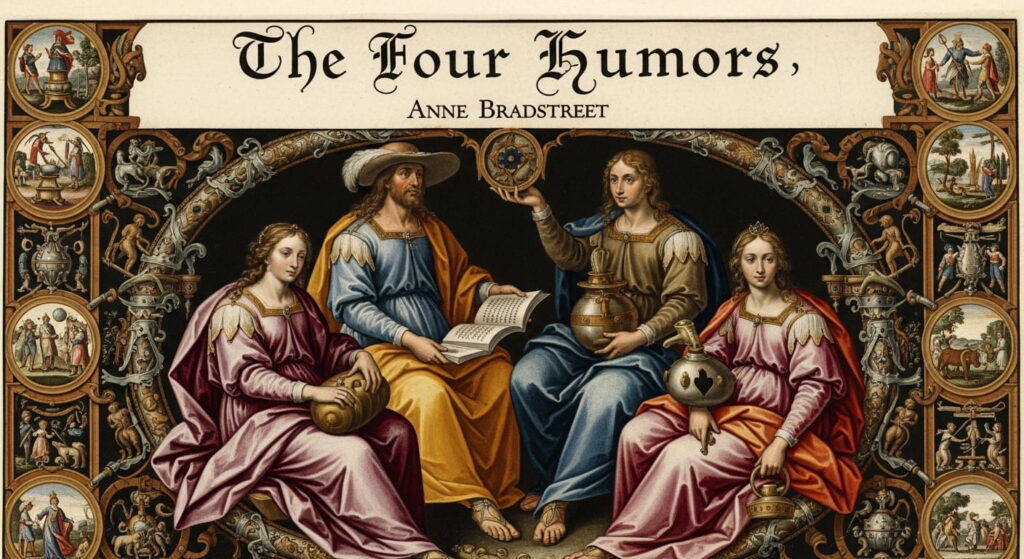
Humoral theory forms the physiological backbone of this poem. Four Ages of Man by Anne Bradstreet applies this ancient system carefully. Hippocrates and Galen developed humoral theory in antiquity. Furthermore, it dominated Western medicine for nearly two millennia. According to this system, four bodily fluids govern health and temperament. Blood produces the sanguine character. Phlegm produces the phlegmatic character. Yellow bile produces the choleric character. Black bile produces the melancholic character. Consequently, each age of life reflects a dominant humour. Additionally, Bradstreet read The Four Humors within her broader quaternion project. Moreover, humoral theory connected medicine to philosophy and theology. The body’s balance reflected cosmic and divine order. Therefore, Bradstreet’s use of humoral theory carried deep significance. Furthermore, she did not apply the theory mechanically. She adapted it creatively to serve her poetic vision. Each humour becomes a living personality in the debate. Consequently, abstract physiology gains dramatic and moral life. The humoral framework enriches every layer of the poem. Additionally, the theory gave Bradstreet’s readers a shared cultural vocabulary. Seventeenth-century readers understood humoral temperaments immediately. Therefore, the poem communicated with precision and cultural resonance. Furthermore, humoral theory connected the individual body to the cosmos. Consequently, medicine and cosmology merged in Bradstreet’s poetic vision.
Elemental and Seasonal Correspondences
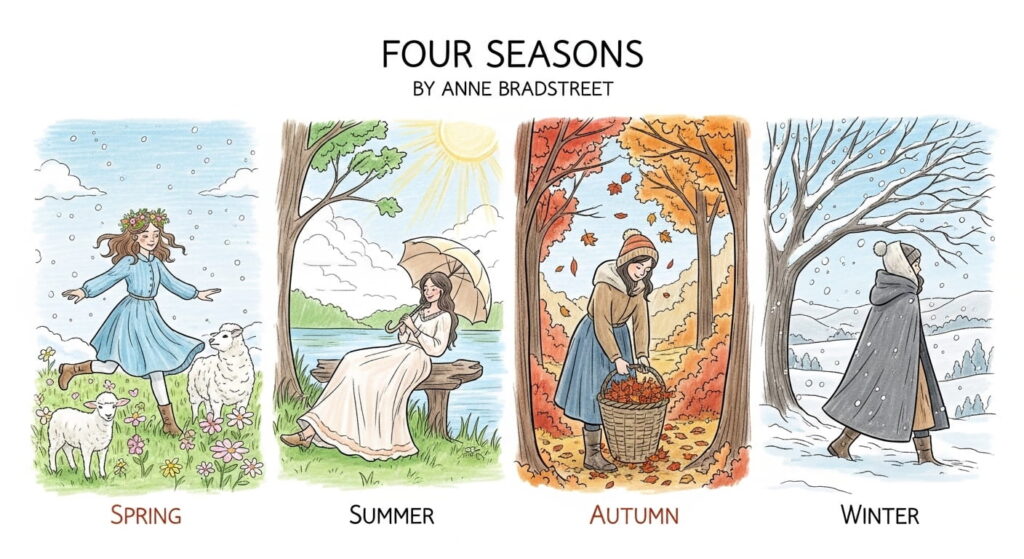
Bradstreet connects the four ages to natural elements and seasons. This correspondence deepens the poem’s philosophical richness considerably. Childhood links to water and the hibernal season of winter. Youth connects to air and the vernal season of spring. Manhood associates with fire and the aestival season of summer. Old Age ties to earth and the autumnal season of harvest. Furthermore, these correspondences were not arbitrary or decorative. They reflected a coherent Renaissance cosmological worldview. Consequently, the human lifespan mirrored the cycle of the year. Additionally, the elemental connections gave each age physical texture. Water suggests Childhood’s fluidity and vulnerability. Air reflects Youth’s freedom and expansive energy. Fire captures Manhood’s consuming ambition and drive. Earth signifies Old Age’s groundedness and proximity to the grave. Moreover, The Four Elements by Bradstreet elaborates these connections further. The two poems illuminate each other when read together. Therefore, understanding elemental correspondences is essential to the poem. Bradstreet used the natural world as a mirror for human life. Consequently, nature and humanity speak the same cosmic language.
Themes in Four Ages of Man by Anne Bradstreet
Four Ages of Man by Anne Bradstreet explores several powerful themes. First, the poem meditates on transience and human vanity. Each age believes itself to be the greatest. Yet each inevitably gives way to the next. Consequently, the poem reveals the emptiness of worldly ambition. Furthermore, the poem explores the theme of mortality. Every age moves closer to death and divine judgment. Additionally, the poem reflects on original sin and human fallibility. Childhood acknowledges inherited sinfulness from the very start. Therefore, the poem carries a deeply Puritan theological message. Moreover, the poem examines contention and debate as a structure. Each age argues its own merits with passion. Yet none wins decisively because all are incomplete. Furthermore, the poem celebrates the cyclical nature of existence. Human life mirrors the seasons and the cosmos. Additionally, the poem meditates on providence and God’s overarching plan. Each age fulfills a divine purpose within creation. Consequently, vanity does not lead to despair in the poem. Instead, it leads toward humility and spiritual acceptance. The poem’s themes are interconnected and mutually reinforcing throughout.
Theological Dimensions: Puritanism and Providence
Puritanism deeply shapes every dimension of this poem. Four Ages of Man by Anne Bradstreet reflects Puritan theology throughout. Puritans believed in God’s absolute sovereignty over all creation. Furthermore, they understood human life as a brief, sublunary journey. Consequently, earthly achievement carried little ultimate significance. Additionally, Puritans emphasized original sin and human unworthiness. These beliefs appear directly in Childhood’s opening speech. The child acknowledges sinfulness as an inherited condition. Therefore, the poem begins with theological humility. Moreover, Bradstreet believed in divine providence guiding all events. Each age of life unfolds according to God’s plan. Furthermore, Old Age’s acceptance of death reflects providential trust. The elder does not rage against mortality. Instead, he accepts it as God’s wise and merciful design. Additionally, the poem’s moral message is explicitly didactic. Bradstreet intended poetry to teach spiritual lessons. Consequently, every argument made by the four ages serves instruction. The poem leads readers from temporal vanity toward eternal truth. Puritanism gives the poem its moral spine and theological depth.
Allegory and Personification as Literary Devices
Allegory and personification give the poem its dramatic power. Four Ages of Man by Anne Bradstreet uses both devices with skill. Each age becomes a living, speaking character. Furthermore, each character embodies abstract philosophical qualities. Consequently, the poem transforms ideas into vivid, argumentative voices. Additionally, allegory allows Bradstreet to teach without preaching directly. The characters demonstrate moral truths through their own words. Therefore, the didactic purpose operates through dramatic enactment. Moreover, personification gives each age a distinct personality. Childhood speaks tentatively and with innocent vulnerability. Youth speaks with passionate energy and youthful pride. Manhood speaks with authority and choleric ambition. Old Age speaks with earned wisdom and reflective gravity. Furthermore, these distinct voices create genuine dramatic tension. Readers find themselves weighing each age’s claims carefully. Additionally, the debate format mirrors classical rhetorical traditions. Bradstreet clearly understood the art of structured argument. Consequently, the allegory is not static but dynamic and energetic. The poem lives and breathes through its allegorical characters. This literary mastery sets the poem apart from mere didactic verse.
The Debate Structure and Contention
The debate structure drives the poem’s intellectual energy. Each age engages in contention with the others. Furthermore, each presents its case with rhetorical confidence. Consequently, the poem reads like a formal philosophical disputation. The reader becomes a judge weighing competing arguments. Additionally, the debate format had deep classical roots. Ancient philosophers and rhetoricians used this structure widely. Therefore, Bradstreet’s choice reflects her classical learning. Moreover, the debate reveals the limits of each age’s perspective. Childhood cannot see beyond its own vulnerability. Youth cannot see beyond its own passion. Manhood cannot see beyond its own ambition. Old Age, however, sees the whole picture most clearly. Furthermore, the structure creates dramatic irony throughout the poem. Each age unknowingly reveals its own weakness. Consequently, the reader gains wisdom the characters themselves lack. Additionally, the debate structure reflects Bradstreet’s Puritan context. Puritans valued reasoned argument and theological disputation. Therefore, the poem’s argumentative form carries cultural significance. The contention between ages models the proper use of reason. Reason must ultimately bow to God’s providential wisdom.
The Role of Macrocosm and Microcosm
Bradstreet organized her poem around an ancient philosophical concept. The macrocosm is the universe as a divine whole. The microcosm is the human being as its mirror. Furthermore, this concept had roots in Greek and Renaissance thought. Consequently, the human body reflected the structure of the cosmos. Each humour corresponded to an element and a celestial quality. Additionally, each age of life reflected a cosmic season. Therefore, human life was not merely personal but universal. Moreover, this macrocosm-microcosm framework gave Bradstreet’s poem scope. She was not merely writing about one human life. She was writing about the structure of creation itself. Furthermore, the framework connected her poem to the quaternion series. The Four Elements and Four Humours poems map the macrocosm. The Four Ages poem maps the human microcosm. Consequently, together these poems present a complete cosmological vision. Additionally, the macrocosm-microcosm framework had theological significance. God designed both the universe and the human body. Therefore, studying humanity meant studying divine creation itself. Bradstreet used this framework to glorify God through poetry.
Vanity, Transience, and the Temporal World
Vanity is one of the poem’s most persistent and powerful themes. Four Ages of Man by Anne Bradstreet returns to it repeatedly. Each age believes itself the greatest and most important. Yet each age fades and gives way to the next. Consequently, the poem demonstrates the vanity of worldly confidence. Furthermore, this theme connects to the biblical book of Ecclesiastes. Ecclesiastes declares that all earthly pursuits are vanity. Bradstreet would have known this text deeply and personally. Additionally, vanity connects to the Puritan distrust of worldly success. Puritans believed that temporal achievement could blind the soul. Therefore, pride in one’s age or stage was spiritually dangerous. Moreover, transience reinforces the vanity theme throughout the poem. Every human stage is brief and inevitably passing. Furthermore, the seasonal imagery drives this point home powerfully. Spring gives way to summer, summer to autumn, autumn to winter. Additionally, the sublunary world is subject to constant change. Only God and eternal life lie beyond this transience. Consequently, the poem urges readers to fix their gaze upward. True wisdom lies in recognizing the temporal world’s limits. Vanity leads to wisdom when it points toward God.
Mortality and Old Age’s Final Wisdom
Mortality stands at the center of the poem’s moral vision. Four Ages of Man by Anne Bradstreet does not flinch from death. Old Age confronts mortality with clear and steady courage. Furthermore, this confrontation carries the poem’s deepest theological message. Consequently, Old Age becomes the poem’s most spiritually significant voice. Additionally, Old Age has survived all the vanities of earlier stages. It has witnessed Childhood’s innocence give way to Youth’s passion. It has watched Manhood’s ambition cool into autumnal reflection. Therefore, Old Age speaks from a position of hard-won wisdom. Moreover, the melancholic temperament suits this final stage perfectly. Cold, dry melancholy produces the deepest philosophical insight. Furthermore, Old Age does not mourn its own decline. Instead, it accepts mortality as God’s providential design. Additionally, the autumnal imagery reinforces this acceptance beautifully. Harvest time demands a reckoning with what has endured. Consequently, Old Age turns from the temporal toward the eternal. Death is not an ending but a transition toward God. Bradstreet uses Old Age to deliver her poem’s ultimate lesson. Mortality, properly understood, leads toward spiritual liberation.
The Prologue and Bradstreet’s Intellectual Authority
Four Ages of Man by Anne Bradstreet must be read alongside her other works. Her famous Prologue addresses critics of female learning directly. Furthermore, that poem defends a woman’s right to intellectual expression. Consequently, the quaternion poems serve as proof of that right. Additionally, Bradstreet did not apologize for her classical knowledge. She displayed it with confidence and scholarly authority. Therefore, the Four Ages poem is implicitly a feminist statement. It demonstrates that a woman can master complex philosophical material. Moreover, the poem draws from humoral theory, cosmology, and theology. These were traditionally masculine domains of knowledge. Furthermore, Bradstreet entered those domains without hesitation or apology. She engaged the greatest intellectual traditions of her age. Additionally, her Puritan community both enabled and limited her. They valued learning yet restricted women’s public roles. Consequently, her poems operated within and against those constraints. The intellectual ambition of Four Ages of Man by Anne Bradstreet was itself a courageous act. It claimed space for women in the life of the mind. This feminist dimension enriches and complicates the poem significantly.
Bradstreet’s Language and Poetic Craft
Bradstreet’s language throughout this poem is precise and deliberate. Each age speaks in diction suited to its character. Furthermore, the verse form gives the poem disciplined structure. Iambic pentameter provides a steady, dignified rhythm. Consequently, the poem balances argument with aesthetic pleasure. Additionally, Bradstreet uses metaphor and imagery with great skill. Childhood’s imagery draws from winter and cold water. Youth’s imagery draws from spring air and warm light. Manhood’s imagery draws from summer fire and fierce heat. Old Age’s imagery draws from autumn earth and fading light. Moreover, the poem uses rhetorical devices with classical awareness. Each age builds its argument through logical accumulation. Furthermore, Bradstreet uses irony to undercut each age’s claims subtly. The reader recognizes what each character cannot see. Additionally, the poem’s diction reflects Bradstreet’s wide reading. She draws from classical, biblical, and Renaissance sources. Consequently, her vocabulary is rich and culturally layered. Furthermore, she avoids obscurity despite her complex subject matter. The poem remains accessible while maintaining intellectual depth. This balance marks Bradstreet as a genuinely accomplished poet.
The Poem Within the Quaternion Series
Four Ages of Man by Anne Bradstreet gains richness from its series context. The quaternion poems form a coherent, interlocking system. Furthermore, each poem illuminates the others significantly. The Four Humours establishes the physiological framework. The Four Elements establishes the cosmological framework. Consequently, the Four Ages poem builds on both preceding works. Additionally, readers who know those poems understand this one more deeply. The correspondence between humours, elements, and ages becomes clear. Therefore, reading the series together reveals Bradstreet’s unified vision. Moreover, the series maps the entire created order systematically. The elements represent the material world. The humours represent the physiological world. The ages represent the biographical world of human experience. Furthermore, together these maps create a complete cosmological portrait. Bradstreet saw the universe as an interconnected, ordered whole. Additionally, the series reflects her Puritan belief in divine design. God created every system with wisdom and purpose. Consequently, exploring these systems honored God’s creative intelligence. The quaternion series is therefore an act of devotion. Bradstreet glorified God through systematic intellectual inquiry.
The Poem’s Place in American Literary History
This poem holds a foundational place in American literary history. It belongs to the very beginning of the American literary tradition. Furthermore, it demonstrates that early American writing was sophisticated. Colonial writers engaged seriously with classical intellectual traditions. Consequently, American literature begins with genuine philosophical ambition. Additionally, Four Ages of Man by Anne Bradstreet established important precedents. It proved that the New World could produce learned, serious poetry. Moreover, it proved that women could contribute to that tradition. Therefore, the poem is more than a literary artifact. It is a milestone in cultural and intellectual history. Furthermore, it connects American literature to its European roots. Bradstreet brought Renaissance and classical traditions to colonial soil. She planted those traditions and adapted them creatively. Additionally, she gave them a distinctly American spiritual urgency. The Puritan context transformed European frameworks into something new. Consequently, the poem occupies a unique crossroads in literary history. It looks back to European tradition and forward to American originality. For broader studies of this tradition, visit americanlit.englishlitnotes.com. Additionally, comprehensive literary resources are available at englishlitnotes.com.
Critical Reception and Scholarly Study
Scholars have given this poem increasing critical attention over decades. Early critics often preferred Bradstreet’s personal and domestic poems. Furthermore, they overlooked the intellectual ambition of the quaternions. However, modern scholarship has significantly reassessed these longer works. Consequently, critics now recognize their philosophical sophistication fully. Additionally, feminist criticism has illuminated new dimensions of the poem. Scholars read it as a performance of female intellectual authority. Therefore, the poem’s cultural significance has expanded considerably. Moreover, scholars of early American literature now place it centrally. It appears in major anthologies and course syllabi regularly. Furthermore, it features in studies of colonial intellectual culture. Bradstreet’s engagement with humoral theory fascinates medical historians. Additionally, literary historians value its Renaissance connections deeply. Consequently, the poem attracts genuinely interdisciplinary scholarly attention. It sits at the crossroads of literature, history, and philosophy. This richness makes it an endlessly productive subject of study. Furthermore, new critical frameworks continue to enrich its reading. Ecocriticism finds its seasonal imagery significant. Therefore, the poem remains alive within contemporary critical discourse. Additionally, scholars of religion find its Puritan framework deeply instructive. Bradstreet’s integration of theology and classical learning is remarkable. Consequently, the poem serves as a model for studying early modern faith and reason together. Furthermore, digital humanities scholars have begun mapping her sources and influences. Therefore, our understanding of the poem continues to deepen with each generation of readers and critics.
Why Students Should Study This Poem
Students gain enormously from a careful study of this poem. First, it teaches the history of scientific and philosophical thought. Humoral theory and cosmological thinking shaped Western culture for centuries. Furthermore, understanding these frameworks illuminates countless other literary works. Consequently, students develop a richer intellectual and cultural vocabulary. Additionally, the poem demonstrates the power of allegorical writing. Allegory turns abstract ideas into vivid, dramatic characters. Therefore, engaging with the poem sharpens analytical reading skills. Moreover, the poem introduces students to early American literary culture. Understanding Bradstreet means understanding American literature’s origins. Furthermore, the poem raises enduring questions about human life. What is the most valuable stage of human existence? These questions remain urgent and personally meaningful. Additionally, the poem models intellectual ambition for every student. Bradstreet tackled the most difficult philosophical material. Therefore, her example inspires students to pursue complex subjects. Moreover, the poem bridges multiple disciplines productively. It connects literature, history, theology, medicine, and philosophy. Consequently, it makes an ideal subject for interdisciplinary study. Every student of literature and history benefits from it. Furthermore, the poem teaches students to read allegorically. This skill transfers across centuries and genres. Additionally, the poem’s debate structure models rigorous argumentation. Therefore, students who study it become better thinkers and writers. Bradstreet’s poem is, in every sense, an education in itself.
Conclusion: The Enduring Legacy of the Poem
Four Ages of Man by Anne Bradstreet endures for powerful reasons. It combines intellectual rigor with genuine poetic artistry beautifully. Furthermore, it maps the entire arc of human existence. From Childhood’s vulnerability to Old Age’s earned wisdom, it covers all. Consequently, readers at every stage find something personally resonant. Additionally, the poem’s theological depth gives it lasting spiritual value. It does not merely describe human life. Instead, it judges, measures, and ultimately redeems it. Therefore, Four Ages of Man by Anne Bradstreet transcends its historical moment. It speaks across centuries with living, urgent force. Moreover, its classical learning remains intellectually stimulating today. The humoral and cosmological frameworks open rich interpretive doors. Furthermore, its feminist dimensions continue to inspire and challenge readers. Bradstreet’s courage in claiming intellectual space remains admirable. Additionally, its Puritan theology speaks to anyone grappling with mortality. Every human being must eventually face Old Age’s questions. Consequently, the poem is not merely historical but profoundly contemporary. It stands as proof of early America’s genius. Bradstreet’s achievement deserves our deepest admiration and continued study. The poem will inspire scholars and readers for generations. Furthermore, it reminds us that poetry can hold everything. It can hold science, theology, philosophy, and personal emotion together. Consequently, Bradstreet’s poem is among the most ambitious in early American literature. Additionally, it models what great poetry can achieve at its best. Therefore, we return to it not merely for information but for wisdom. The Four Ages of Man speaks to every human soul honestly and generously.
Original Sin, Moral Fallibility, and Human Limitation
Four Ages of Man by Anne Bradstreet confronts human sinfulness with directness. Original sin sits at the heart of Puritan theology. Bradstreet accepted this doctrine with full conviction. Furthermore, she wove it into the poem’s very opening. Childhood acknowledges sinfulness before claiming any virtue. Consequently, the poem begins from a position of theological humility. Additionally, each subsequent age displays its own form of moral limitation. Youth’s passion becomes vanity and self-love. Manhood’s ambition becomes pride and worldly overreach. Old Age alone achieves a measure of moral clarity. Therefore, the poem traces a spiritual journey through human limitation. Moreover, original sin connects to the poem’s didactic purpose. Bradstreet did not write merely to entertain readers. She wrote to remind them of their fallen condition. Furthermore, this reminder carried genuine compassion and pastoral care. The poet understood human weakness from personal experience. She suffered illness, loss, and hardship throughout her life. Additionally, her personal suffering deepened her theological wisdom. Consequently, the poem’s treatment of human fallibility feels earned and authentic. Bradstreet writes not as a judge but as a fellow traveler on the path toward grace.
The Poem’s Relevance to Modern Readers
The poem speaks with remarkable relevance to modern readers. Four Ages of Man by Anne Bradstreet is not merely a historical document. Furthermore, its central questions remain deeply urgent today. Every human being passes through the stages of life. Consequently, every reader finds personal resonance in the poem. Additionally, the poem’s meditation on vanity carries modern weight. Contemporary culture obsesses over youth and worldly success. Therefore, Bradstreet’s challenge to those values is timely. Moreover, the poem’s treatment of Old Age speaks powerfully now. Aging populations across the world grapple with mortality. Furthermore, Old Age’s wisdom offers a counter-cultural perspective. The elder’s voice insists that depth surpasses surface vitality. Additionally, the poem’s Puritan theology need not alienate secular readers. Its core messages transcend any single religious tradition. Consequently, readers from many backgrounds find meaning in it. The poem asks all of us to examine our lives honestly. It urges humility, reflection, and openness to mortality. Furthermore, it celebrates the dignity of every human stage. Therefore, the poem remains a living text for any era. Its wisdom endures precisely because it addresses the universal.
Discover more from Welcome to My Site of American Literature
Subscribe to get the latest posts sent to your email.