Introduction
Anne Bradstreet wrote some of the finest colonial American poetry. Furthermore, her poem Four Seasons by Anne Bradstreet stands as one of her most celebrated and symbolically rich works. Therefore, this article provides a complete and carefully structured analysis. Additionally, the poem explores the four seasons as metaphors for human life stages. Consequently, readers discover deep moral and spiritual lessons throughout the poem. Moreover, Bradstreet connects nature’s cycles to divine providence consistently. Thus, the poem reflects her strong Puritan faith and intellectual depth. Meanwhile, her use of seasonal imagery remains remarkably vivid and compelling. However, the poem transcends its historical context entirely. Furthermore, it speaks directly to universal human experiences of time and change. Therefore, students, teachers, and scholars all find great value in this work. Additionally, this analysis covers biography, themes, symbolism, and literary techniques. Consequently, every major dimension of the poem receives careful and detailed attention. For more on Bradstreet’s related works, visit Four Elements by Bradstreet. Overall, this article serves as the most complete guide available.
1. Anne Bradstreet Biography
Anne Bradstreet was born in Northampton, England, in 1612. Furthermore, she received an unusually excellent education for a woman of her era. Therefore, she developed sophisticated literary and intellectual skills early. Additionally, she emigrated to Massachusetts Bay Colony in 1630. Consequently, she became one of America’s very first published poets. Moreover, she married Simon Bradstreet, a prominent colonial administrator. Thus, her domestic and public life shaped her poetic vision deeply. Meanwhile, she raised eight children while writing remarkable literary work. However, she faced serious illness and personal hardship consistently. Furthermore, her faith sustained her through every trial and difficulty. Therefore, her biography provides essential context for her poetry. Additionally, her Puritan beliefs permeate every poem she ever wrote. Consequently, understanding her life means understanding her art completely. For extensive resources on colonial period poetry, readers should visit colonial and early national period poetry. Overall, Bradstreet remains a towering figure in American literary history.
2. Anne Bradstreet Poetry
Anne Bradstreet’s poetry reflects deep learning and genuine emotional power. Furthermore, she drew heavily on classical and biblical literary traditions. Therefore, her work demonstrates remarkable intellectual range and ambition. Additionally, she wrote on domestic life, faith, nature, and mortality. Consequently, her poetry resonates across many different thematic categories. Moreover, she published The Tenth Muse Lately Sprung Up in America in 1650. Thus, she became the first published American poet of significance. Meanwhile, her poems balance personal emotion with philosophical reflection. However, she always grounded her work in Puritan theological principles. Furthermore, her poetry reveals a woman of extraordinary courage and creativity. Therefore, studying her poetry means engaging with America’s earliest literary voice. Additionally, her range extends from epic quaternions to intimate domestic lyrics. Consequently, Four Seasons by Anne Bradstreet represents the quaternion tradition at its finest. For further reading on Bradstreet’s complete poetic output, visit americanlit.englishlitnotes.com. Overall, her poetry deserves sustained scholarly and student attention.
3. Anne Bradstreet Poems
Among Bradstreet’s most celebrated poems, the quaternion series stands out prominently. Furthermore, this series includes the Four Elements, Four Humors, Four Ages of Man, and Four Seasons. Therefore, each poem in the series explores a different fourfold natural or human category. Additionally, these quaternion poems reflect Renaissance cosmological and philosophical traditions. Consequently, they demonstrate Bradstreet’s extraordinary intellectual ambition and learning. Moreover, Four Seasons by Anne Bradstreet completes this remarkable and interconnected poetic series. Thus, it deserves study both independently and within its larger context. Meanwhile, her domestic poems like To My Dear and Loving Husband show her personal emotional depth. However, the quaternion poems reveal her philosophical and theological range. Furthermore, her poems on mortality show her Puritan acceptance of death. Therefore, Bradstreet’s poems collectively create a uniquely rich literary world. Additionally, every poem reflects her dual identity as poet and Puritan believer. For notes on the companion poem, see Four Ages of Man by Anne Bradstreet. Overall, her poems represent colonial America’s finest literary achievement.
4. Four Seasons by Anne Bradstreet
The poem Four Seasons by Anne Bradstreet forms the final part of her quaternion poetic series. Furthermore, it belongs alongside the Four Elements and Four Humors poems. Therefore, reading it within this series deepens understanding significantly. Additionally, each season in the poem speaks directly and independently. Consequently, the poem uses a dramatic monologue structure effectively. Moreover, spring, summer, autumn, and winter each claim supremacy confidently. Thus, the poem creates a lively and intellectually engaging debate. Meanwhile, Bradstreet uses this debate format with great dramatic skill. However, no season ultimately wins the philosophical argument. Furthermore, the debate itself reveals the interconnectedness of all seasons. Therefore, Four Seasons by Anne Bradstreet argues implicitly for balance and divine order. Additionally, the poem reflects classical and Renaissance literary traditions. Consequently, it connects American colonial poetry to European intellectual heritage. For a related companion text, readers should consult Four Humors by Anne Bradstreet. Overall, the poem represents Bradstreet’s finest quaternion achievement.
5. Four Seasons Poem Summary
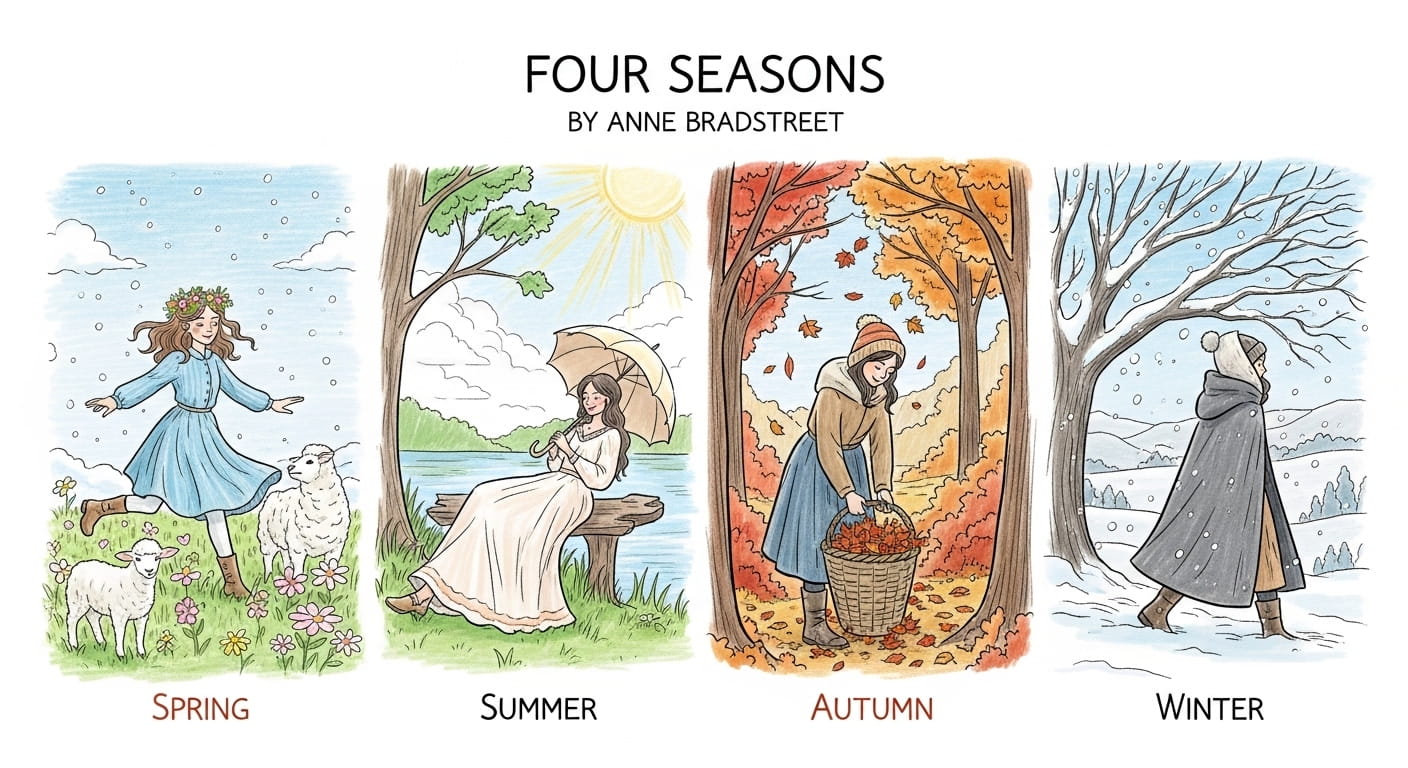
In Four Seasons by Anne Bradstreet, each of the four seasons delivers a formal self-defence speech. Furthermore, Spring opens the poem with claims of youth and renewal. Therefore, she argues that she brings life back to all creation. Additionally, Summer follows with claims of warmth, abundance, and harvest. Consequently, Summer presents herself as the most productive of all seasons. Moreover, Autumn claims the reward of Summer’s earlier plentiful labours. Thus, Autumn argues for her role as the season of fulfilment. Meanwhile, Winter closes the debate with claims of age and wisdom. However, Winter also acknowledges her association with death and rest. Furthermore, each season’s speech mirrors a corresponding human life stage. Therefore, the poem creates a richly layered symbolic narrative structure. Additionally, Bradstreet frames the debate within a divine cosmic order. Consequently, readers understand that all seasons serve God’s greater purpose. For broader context in American poetry tradition, visit americanlit.englishlitnotes.com. Overall, the summary reveals the poem’s elegant allegorical structure.
6. Four Seasons Poem Meaning
The deeper meaning of Four Seasons by Anne Bradstreet operates on multiple interconnected levels simultaneously. Furthermore, at the surface level, the poem describes the four natural seasons. Therefore, spring, summer, autumn, and winter each receive detailed description. Additionally, at a deeper level, the seasons represent the stages of human life. Consequently, spring symbolizes childhood, summer represents young adulthood clearly. Moreover, autumn corresponds to middle age and accumulated experience. Thus, winter embodies old age, wisdom, and approaching death. Meanwhile, at the deepest level, the poem reflects Puritan theological belief. However, the poem never descends into simple or mechanical allegory. Furthermore, Bradstreet maintains poetic richness and genuine emotional depth throughout. Therefore, the meaning of the poem grows richer with each careful reading. Additionally, God’s providential order underlies every seasonal transition in the poem. Consequently, the poem’s meaning ultimately points toward divine sovereignty and grace. For related thematic analysis, visit englishlitnotes.com. Overall, the poem’s meaning rewards sustained and careful scholarly engagement.
7. Four Seasons Poem Analysis
A careful analysis of Four Seasons by Anne Bradstreet reveals extraordinary poetic craft and structural sophistication. Furthermore, Bradstreet uses the dramatic monologue form with great skill. Therefore, each season speaks in a confident and distinctly individual voice. Additionally, the poem employs iambic pentameter with occasional variations throughout. Consequently, the rhythm mirrors the natural rise and fall of seasons. Moreover, Bradstreet deploys rich and precise descriptive imagery throughout. Thus, readers see spring’s flowers, summer’s heat, and winter’s frost. Meanwhile, the rhetorical structure of each speech follows classical debate traditions. However, the debate never becomes dry or academically tedious. Furthermore, Bradstreet maintains emotional warmth and poetic beauty consistently. Therefore, the analysis reveals a poem of genuine artistic achievement. Additionally, the parallel structure between the four speeches creates formal elegance. Consequently, each season’s speech mirrors the others in structure but differs in content. For the companion quaternion poem’s analysis, see Four Elements by Bradstreet. Overall, the analysis confirms Bradstreet’s mastery of the quaternion tradition.
8. Four Seasons Interpretation
Interpreting Four Seasons by Anne Bradstreet requires attention to its multiple symbolic layers simultaneously. Furthermore, the most immediate interpretation concerns the natural world itself. Therefore, the poem celebrates nature’s beauty, power, and cyclical order. Additionally, a second interpretation connects the seasons to human life stages. Consequently, the poem becomes a meditation on mortality and the passage of time. Moreover, a third interpretation places the poem within Puritan theological tradition. Thus, every season serves God’s sovereign and providential design perfectly. Meanwhile, a fourth interpretation reads the poem as a classical philosophical debate. However, all four interpretations complement rather than contradict each other. Furthermore, Bradstreet skillfully layers these interpretive levels throughout the poem. Therefore, interpretation depends partly on which layer the reader chooses to emphasize. Additionally, students often find the life-stage interpretation most immediately accessible. Consequently, scholars frequently prefer the theological and cosmological interpretive frameworks. For extensive resources on Bradstreet’s poems, explore colonial and early national period poetry. Overall, the poem rewards interpretation at every possible level of reading.
9. Literary Analysis Anne Bradstreet
Literary analysis of Bradstreet reveals a remarkably sophisticated poetic intelligence. Furthermore, she successfully integrates classical learning with Puritan theological conviction. Therefore, her poems operate at both intellectual and devotional levels simultaneously. Additionally, her use of the quaternion form reflects Renaissance cosmological tradition. Consequently, she connects colonial American poetry to broader European literary heritage. Moreover, she demonstrates mastery of poetic form, rhetoric, and imagery consistently. Thus, literary analysis places her among the finest early American writers. Meanwhile, her domestic poems reveal a different but equally accomplished artistic voice. However, her quaternion poems demonstrate her greatest intellectual and formal ambitions. Furthermore, literary analysis reveals her remarkable skill in handling abstract concepts poetically. Therefore, students of American literature must engage seriously with her work. Additionally, her poetic achievement exceeded what contemporaries expected from women writers. Consequently, she challenged and expanded the possibilities of colonial American poetry. Overall, literary analysis consistently confirms Bradstreet’s status as a major poet.
10. Anne Bradstreet Literary Themes
The major literary themes in Four Seasons by Anne Bradstreet and Bradstreet’s broader work include several interconnected concerns. Furthermore, the theme of divine providence runs through every line she ever wrote. Therefore, God’s sovereign control over nature and human life remains central. Additionally, the theme of transience and mortality appears consistently throughout her poetry. Consequently, seasons change and human life passes with unavoidable inevitability. Moreover, the theme of natural beauty coexists with awareness of its impermanence. Thus, Bradstreet celebrates creation while acknowledging its temporary character. Meanwhile, the theme of Puritan faith shapes every philosophical conclusion she draws. However, her themes never feel narrow or sectarian in their appeal. Furthermore, universal human experiences of love, loss, and faith transcend religious boundaries. Therefore, her themes speak to readers across centuries and cultural contexts. Additionally, the theme of female identity and intellectual ambition appears subtly throughout. Consequently, she asserts a woman’s right to write, think, and publish. Overall, her literary themes combine personal depth with universal philosophical resonance.
11. Symbolism in Anne Bradstreet
Symbolism operates at the very heart of Four Seasons by Anne Bradstreet throughout its entire length. Furthermore, spring functions as the primary symbol of youth, hope, and new life. Therefore, spring’s flowers and warmth represent childhood’s innocence and promise. Additionally, summer symbolizes the productive energy and strength of young adulthood. Consequently, summer’s heat and abundance suggest human life at its peak. Moreover, autumn symbolizes the rich harvest of accumulated wisdom and experience. Thus, autumn’s fruits represent middle age’s achievements and responsibilities. Meanwhile, winter serves as the most complex and resonant symbol in the poem. However, winter represents not only death but also wisdom, rest, and fulfilment. Furthermore, snow, frost, and bare trees symbolize life’s final and inevitable stage. Therefore, symbolism in Bradstreet operates with remarkable consistency and depth. Additionally, the seasons collectively symbolize God’s providential order over all creation. Consequently, natural symbols carry theological weight throughout the entire poem. For detailed notes on companion symbolism, visit Four Ages of Man by Anne Bradstreet. Overall, symbolism gives the poem its most enduring literary power.
12. Seasonal Imagery in Poetry
Seasonal imagery has a long and distinguished history in literary tradition. Furthermore, poets across centuries have used seasons to explore human experience. Therefore, seasonal imagery provides a universally recognizable symbolic framework. Additionally, spring consistently symbolizes birth, renewal, and innocent hope across cultures. Consequently, readers from any background understand spring’s symbolic significance immediately. Moreover, summer imagery typically conveys energy, passion, and productive abundance. Thus, summer serves as a natural symbol of human life at its fullest. Meanwhile, autumn imagery suggests harvest, reflection, and approaching change. However, autumn also carries beautiful and melancholic poetic associations consistently. Furthermore, winter imagery most powerfully evokes death, rest, and ultimate endings. Therefore, seasonal imagery gives poets access to the deepest human concerns. Additionally, Bradstreet deploys this tradition with extraordinary skill and originality. Consequently, her seasonal imagery transcends conventional usage to achieve genuine poetic power. Overall, seasonal imagery remains one of poetry’s most powerful and enduring symbolic resources.
13. Nature in Poetry
Nature has always provided poetry with its richest and most universal subject matter. Furthermore, poets use natural phenomena to explore the full range of human experience. Therefore, nature in poetry serves simultaneously as subject, symbol, and philosophical lens. Additionally, Bradstreet’s treatment of nature reflects her Puritan belief in creation’s goodness. Consequently, she sees nature not as independent but as God’s intentional handiwork. Moreover, every natural detail in her poetry points toward a divine creator. Thus, nature in Bradstreet’s poetry is simultaneously descriptive and devotional throughout. Meanwhile, her descriptions of seasonal change achieve vivid and accurate beauty. However, natural description always serves a larger moral or theological purpose. Furthermore, nature in her poetry never becomes merely decorative or aesthetically self-indulgent. Therefore, her treatment of nature reflects both artistic skill and theological conviction. Additionally, nature in Bradstreet connects her work to broader traditions of religious poetry. Consequently, she participates in a conversation extending from the Psalms to her own era. Overall, Bradstreet’s treatment of nature in poetry achieves genuine and lasting literary distinction.
14. Life Stages in Poetry
The representation of life stages is central to Four Seasons by Anne Bradstreet and its thematic design. Furthermore, poets have long used natural cycles to explore human development. Therefore, the correspondence between seasons and life stages feels both natural and inevitable. Additionally, spring maps precisely onto the innocence and freshness of childhood. Consequently, summer corresponds to the energy and passion of young adulthood. Moreover, autumn captures the reflective wisdom of mature middle age beautifully. Thus, winter represents the final stage of old age and approaching death. Meanwhile, this seasonal life-stage correspondence carries deep emotional and moral resonance. However, Bradstreet treats each stage with equal dignity and philosophical seriousness. Furthermore, no stage is presented as superior or inferior to any other. Therefore, each life stage receives its due respect and thoughtful celebration. Additionally, life stages in poetry connect individual experience to universal human cycles. Consequently, readers of all ages find their own experience reflected in the poem. Overall, life stages in poetry give Four Seasons by Anne Bradstreet its most immediately accessible and emotionally resonant dimension.
15. Poetry Symbolism Explained
Symbolism in poetry means using concrete images to represent abstract ideas. Furthermore, effective symbols operate simultaneously at literal and figurative levels. Therefore, readers engage with the poem’s surface narrative and deeper meaning together. Additionally, the best symbols feel both inevitable and richly suggestive in context. Consequently, skilled poets choose symbols that carry multiple resonant meanings simultaneously. Moreover, seasonal symbols work particularly well because they reflect universal human experience. Thus, everyone knows spring’s renewal, summer’s heat, and winter’s cold intimately. Meanwhile, symbolic depth distinguishes great poetry from merely competent verse. However, symbolism requires careful interpretation and sustained readerly attention. Furthermore, surface readings that ignore symbolic depth miss the poem’s richest meanings. Therefore, students must learn to read poetry at multiple interpretive levels. Additionally, Bradstreet’s symbolism rewards patient and careful interpretive engagement consistently. Consequently, each re-reading reveals new symbolic layers and connections. Overall, understanding poetry symbolism unlocks the deepest pleasures of literary reading.
16. Moral Lessons in Poetry
The moral lessons in Four Seasons by Anne Bradstreet reflect Bradstreet’s deep Puritan ethical convictions. Furthermore, the poem teaches that every life stage carries its own dignity and worth. Therefore, readers learn to accept and honour each phase of human existence. Additionally, the poem teaches that natural cycles reflect God’s wise and benevolent design. Consequently, accepting seasonal change means accepting divine providence gratefully. Moreover, the poem teaches that death is not a tragedy but a natural completion. Thus, winter’s arrival should produce reflection rather than fear or despair. Meanwhile, the moral lesson of balance runs through the entire poem. However, no single season or life stage dominates the others inappropriately. Furthermore, the poem teaches the virtue of contentment within one’s current season. Therefore, moral lessons in Bradstreet’s poetry promote acceptance, gratitude, and faith. Additionally, these moral teachings remain relevant and powerful for contemporary readers. Consequently, the poem serves both aesthetic and ethical purposes simultaneously. For broader moral and thematic context, explore colonial and early national period poetry. Overall, moral lessons give Four Seasons by Anne Bradstreet its most enduring practical and spiritual significance.
17. Poetry of Morality
The poetry of morality has a long and distinguished tradition in English literature. Furthermore, moralistic poetry uses narrative, symbol, and image to teach ethical lessons. Therefore, the poem’s moral purpose never undermines its genuine artistic achievement. Additionally, Bradstreet belongs firmly within this tradition of didactic yet beautiful poetry. Consequently, her poems teach without becoming preachy or aesthetically heavy-handed. Moreover, moral poetry at its best combines beauty with instructive philosophical purpose. Thus, Bradstreet achieves this difficult balance with remarkable consistency and grace. Meanwhile, her moralistic poetry reflects specifically Puritan theological and ethical values. However, her moral vision extends beyond sectarian boundaries to universal human concerns. Furthermore, the poetry of morality serves both individual and communal spiritual purposes. Therefore, her poems function as both private devotions and public ethical teaching. Additionally, moralistic poetry occupied a central place in colonial American culture. Consequently, Bradstreet’s moral poetry served real social and theological functions. Overall, the poetry of morality represents one of literary tradition’s oldest and most enduring strands.
18. Puritan Poetry
Puritan poetry provides the essential cultural and theological context for Four Seasons by Anne Bradstreet. Furthermore, Puritan poets believed that all human creativity must glorify God. Therefore, poetry served devotional and moral rather than merely aesthetic purposes. Additionally, Puritan poetry typically avoided excessive ornamentation or self-indulgent beauty. Consequently, plain style and clarity were valued above elaborate rhetorical flourishes. Moreover, Bradstreet’s poetry both reflects and transcends these Puritan aesthetic principles. Thus, she achieves genuine beauty within the constraints of Puritan belief. Meanwhile, Puritan poetry also engaged with classical and Renaissance literary traditions. However, classical learning was always subordinated to scriptural and theological authority. Furthermore, Bradstreet represents the finest flowering of the Puritan poetic tradition. Therefore, understanding Puritan poetry means understanding the culture that shaped her work. Additionally, Puritan beliefs about providence, sin, death, and salvation permeate her verse. Consequently, Four Seasons by Anne Bradstreet reflects these theological convictions at every structural level. For more on Puritan and colonial poetry, visit colonial and early national period poetry. Overall, Puritan poetry gave Bradstreet the intellectual and spiritual framework for her greatest work.
19. Puritan Literature Analysis
Puritan literature analysis reveals a rich and complex literary tradition. Furthermore, Puritan writers engaged seriously with Scripture, classical learning, and personal experience. Therefore, Puritan literature combines theological conviction with genuine intellectual depth. Additionally, the plain style of Puritan writing values clarity, directness, and precision. Consequently, Puritan literary analysis must attend to both form and theological content. Moreover, Puritan literature analysis reveals how faith shapes every artistic choice. Thus, even structural decisions in Puritan poetry carry theological significance. Meanwhile, Puritan writers like Bradstreet broke significant cultural and gender barriers. However, they always framed these achievements within humble Puritan theological terms. Furthermore, Puritan literature analysis reveals tensions between personal expression and communal belief. Therefore, analysis must consider both the individual voice and the communal context. Additionally, Puritan literature analysis connects colonial American writing to its European origins. Consequently, it reveals how English Reformed theology shaped American literary culture. Overall, Puritan literature analysis provides essential tools for understanding colonial American writing.
20. American Colonial Poetry
American colonial poetry represents the very beginning of a great literary tradition. Furthermore, colonial poets worked in challenging physical, social, and cultural conditions. Therefore, their literary achievements deserve recognition and serious scholarly attention. Additionally, Four Seasons by Anne Bradstreet stands as one of American colonial poetry’s finest and most enduring works. Consequently, Bradstreet established the possibility of serious literary achievement in the new world. Moreover, colonial poetry drew on English literary traditions while developing new American themes. Thus, the tension between old world inheritance and new world experience enriches the poetry. Meanwhile, colonial poets also engaged with indigenous American nature and landscape. However, Bradstreet’s colonial poetry remains primarily within English literary tradition. Furthermore, American colonial poetry reflects the Puritan mission to build a godly society. Therefore, poetry served both aesthetic and civic theological purposes simultaneously. Additionally, colonial poetry established patterns and themes for all subsequent American literature. Consequently, Bradstreet’s colonial achievement shaped American literary identity profoundly. For extensive resources on this literary period, explore colonial and early national period poetry. Overall, American colonial poetry deserves recognition as the foundation of a great literary tradition.
21. American Literature Poetry
American literature poetry has its deepest roots in the colonial period. Furthermore, Bradstreet’s work established the foundational patterns of American poetic tradition. Therefore, understanding American literature poetry means beginning with Bradstreet’s achievement. Additionally, American poetry developed distinctive themes of nature, faith, and individual identity. Consequently, these themes connect Bradstreet’s colonial work to later American poetry. Moreover, American literature poetry reflects the nation’s extraordinary cultural and religious diversity. Thus, from Puritan New England to the diverse present, poetry captures American experience. Meanwhile, Bradstreet’s contribution to American literature poetry remains foundational and irreplaceable. However, her work often receives less attention than later American poets. Furthermore, students of American literature poetry must engage seriously with her work. Therefore, Four Seasons by Anne Bradstreet deserves a central place in American literature curricula. Additionally, her poetry connects American literary tradition to European Renaissance and Reformation culture. Consequently, American literature poetry begins not in isolation but in rich cultural inheritance. For comprehensive American literature poetry resources, visit americanlit.englishlitnotes.com. Overall, American literature poetry finds its earliest and finest expression in Bradstreet’s work.
22. 17th-Century Poetry
The seventeenth century produced some of English literature’s greatest and most enduring poetry. Furthermore, this era saw the flourishing of metaphysical, Puritan, and classical poetic traditions. Therefore, Four Seasons by Anne Bradstreet belongs to one of literary history’s most extraordinarily productive periods. Additionally, seventeenth-century poetry engaged deeply with theological, philosophical, and scientific questions. Consequently, poets like Bradstreet, Milton, Donne, and Herbert shaped the entire subsequent tradition. Moreover, seventeenth-century poetry in America developed distinctly from its English counterpart. Thus, colonial conditions and Puritan theology gave American poetry its unique character. Meanwhile, seventeenth-century poets demonstrated remarkable formal ambition and intellectual range. However, they always grounded formal experimentation in moral and theological seriousness. Furthermore, seventeenth-century poetry rewards sustained reading and careful scholarly analysis. Therefore, students of literary history must engage with this period comprehensively. Additionally, seventeenth-century poetry established formal traditions that shaped centuries of subsequent writing. Consequently, understanding this period means understanding the foundations of modern English poetry. For broader literary historical context, visit englishlitnotes.com. Overall, seventeenth-century poetry represents one of literary history’s most remarkable and productive periods.
23. Poetry on Seasons
Poetry on seasons has a history extending back to ancient Greek and Latin literature. Furthermore, seasonal poetry provides poets with an endlessly rich and universally accessible subject. Therefore, the seasons offer natural symbols for every dimension of human experience. Additionally, Four Seasons by Anne Bradstreet represents one of the finest examples of seasonal poetry in English. Consequently, Bradstreet transforms seasonal description into profound philosophical meditation. Moreover, poetry on seasons appeals immediately to readers of all ages and backgrounds. Thus, everyone recognises the emotional resonance of spring’s renewal and winter’s cold. Meanwhile, seasonal poetry allows poets to explore time, mortality, and divine order. However, the best seasonal poetry transcends mere description to achieve symbolic depth. Furthermore, Bradstreet achieves this transcendence with extraordinary skill and consistency. Therefore, her seasonal poetry deserves recognition as a landmark achievement. Additionally, poetry on seasons connects Bradstreet to a tradition including Spenser, Shakespeare, and Keats. Consequently, she participates in one of English literature’s richest and most continuous traditions. For more on related seasonal themes, see Four Humors by Anne Bradstreet. Overall, poetry on seasons finds one of its finest expressions in Bradstreet’s quaternion poems.
24. Classic Literature for Students
Classic literature offers students irreplaceable opportunities for intellectual and moral growth. Furthermore, engaging with classic texts develops critical thinking, empathy, and cultural awareness. Therefore, teachers and students benefit enormously from engaging with Bradstreet’s poetry. Additionally, Four Seasons by Anne Bradstreet is particularly well-suited to high school and university literature study. Consequently, its themes of nature, life stages, and mortality resonate with young readers. Moreover, the poem’s clear allegorical structure makes it accessible for student analysis. Thus, students can engage with its multiple symbolic layers without feeling overwhelmed. Meanwhile, classic literature connects students to the roots of their own cultural tradition. However, it also challenges students to think beyond their immediate contemporary experience. Furthermore, Bradstreet’s work helps students understand the origins of American literary culture. Therefore, every student of American or English literature should encounter her work. Additionally, classic literature for students provides models of serious and sustained thinking. Consequently, engaging with Bradstreet’s poetry develops exactly the skills education aims to cultivate. For comprehensive student and teacher resources on literary analysis, visit englishlitnotes.com. Overall, classic literature remains the most valuable and enduring foundation for literary education.
25. Four Seasons Poem Summary for Students
Students approaching Four Seasons by Anne Bradstreet for the first time benefit from a clear structural overview. Furthermore, the poem opens with Spring speaking confidently and proudly about her gifts. Therefore, Spring claims credit for reviving life after winter’s long dominance. Additionally, she describes flowers, warmth, birds, and the return of natural abundance. Consequently, Spring presents herself as the most beloved of all four seasons. Moreover, Summer speaks next with equal confidence and greater intensity. Thus, Summer claims the harvest’s abundance and the sun’s powerful warmth. Meanwhile, Autumn follows with claims of maturity and agricultural fulfilment. However, Autumn also acknowledges that she prepares the world for winter’s arrival. Furthermore, Winter speaks last and makes the most philosophically rich speech. Therefore, Winter claims wisdom, rest, and the completion of the natural cycle. Additionally, Winter connects physical cold to spiritual depth and contemplative life. Consequently, each season’s summary reveals a distinct philosophical and emotional character. For the complete quaternion context, see Four Ages of Man by Anne Bradstreet. Overall, the poem’s summary reveals a beautifully structured and thematically rich allegorical debate.
Conclusion
The poem Four Seasons by Anne Bradstreet stands as one of colonial American literature’s greatest achievements. Furthermore, Bradstreet combines seasonal description with profound philosophical and theological reflection. Therefore, the poem rewards readers at multiple interpretive levels simultaneously. Additionally, it demonstrates Bradstreet’s extraordinary intellectual range and genuine poetic skill. Consequently, Four Seasons by Anne Bradstreet deserves a central place in both American and English literary study. Moreover, its themes of life stages, mortality, divine providence, and natural beauty remain universally resonant. Thus, students, teachers, and scholars all find rich material in this remarkable poem. Meanwhile, the poem connects colonial American poetry to its broadest literary and cultural inheritance. However, it also establishes distinctly American themes and perspectives with great originality. Furthermore, every reading of the poem reveals new layers of symbolic and philosophical meaning. Therefore, Four Seasons by Anne Bradstreet represents the very best of what Puritan colonial poetry achieved. Additionally, Bradstreet’s achievement challenges and expands our understanding of early American literary culture. Consequently, this analysis confirms the poem as a masterwork deserving sustained scholarly and student attention. For further exploration of Bradstreet’s related works, visit Four Elements by Bradstreet and Four Humors by Anne Bradstreet. Overall, Four Seasons by Anne Bradstreet leaves every reader with a deeper appreciation of nature, faith, and the beauty of human life.
Discover more from Welcome to My Site of American Literature
Subscribe to get the latest posts sent to your email.