Introduction
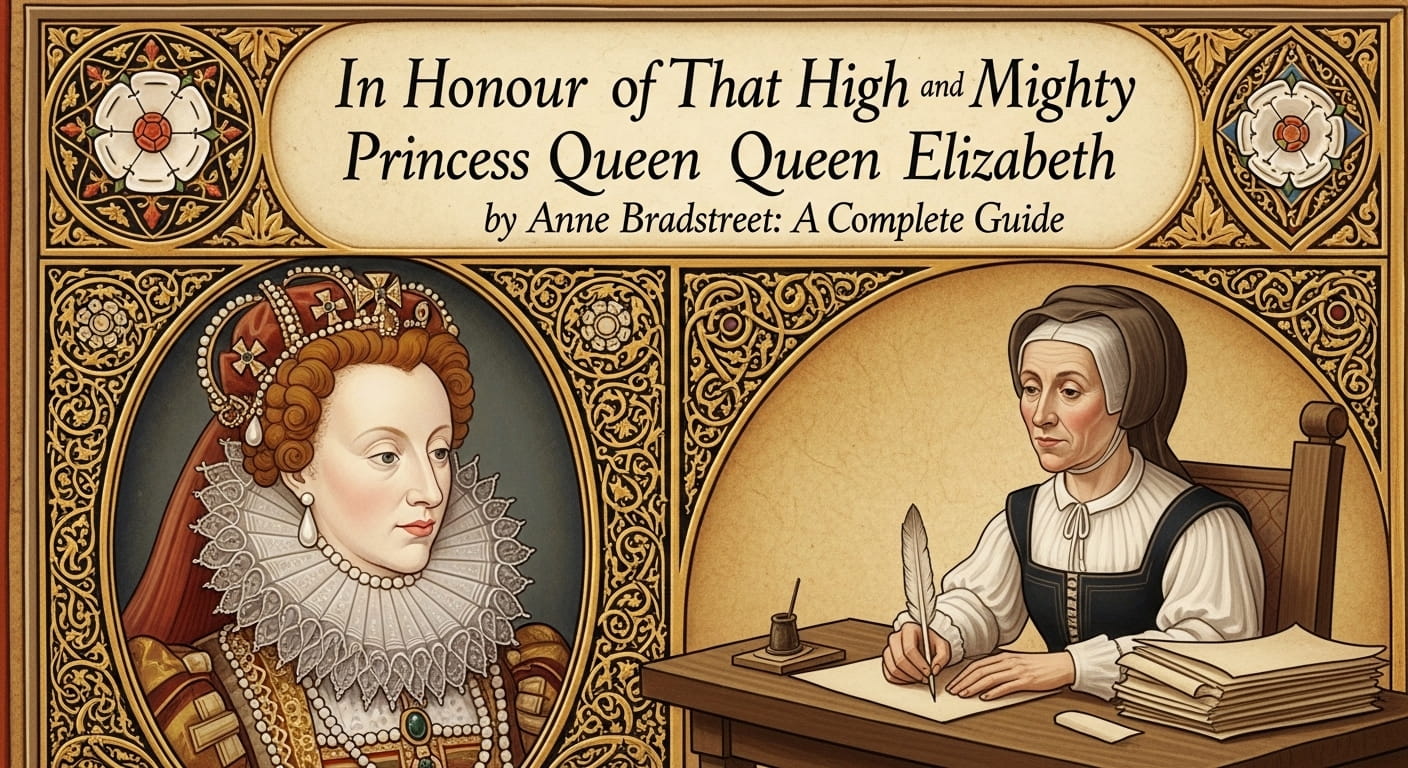
Anne Bradstreet stands as America’s first significant published poet. She wrote with intellectual courage, feminist conviction, and remarkable poetic skill. Her works reflect the Puritan world she inhabited deeply. Yet they also transcend that world with extraordinary ambition. In Honour of That High and Mighty Princess Queen Elizabeth stands among her most politically bold and intellectually ambitious poems. It celebrates the life, reign, and legacy of England’s greatest monarch. Furthermore, it makes a powerful argument for female intellectual and political authority. Consequently, the poem carries enormous feminist and historical significance. Additionally, it connects naturally to Bradstreet’s broader literary project. Her Prologue already defended women’s right to intellectual expression boldly. Her Author to Her Book revealed the personal cost of female authorship openly. Therefore, this poem extends and deepens that feminist argument powerfully. It uses Queen Elizabeth as the ultimate proof of female greatness. This complete guide explores every significant dimension of the poem.
1. Anne Bradstreet: Life and Political Awareness
Anne Bradstreet was born around 1612 in Northampton, England. She arrived in the Massachusetts Bay Colony in 1630. Furthermore, her father, Thomas Dudley, served as colonial governor. Consequently, she grew up surrounded by political awareness and serious learning. She read widely in history, theology, and Renaissance literature. Therefore, her poetry reflects extraordinary intellectual and political breadth. She was born just nine years after Queen Elizabeth died in 1603. Consequently, Elizabeth’s legendary reign shaped the culture Bradstreet was born into. Additionally, Elizabeth represented the pinnacle of female achievement in English history. Therefore, she was a natural subject for Bradstreet’s feminist poetic project. Moreover, Bradstreet wrote as a Puritan woman in colonial America. She inhabited a world that severely restricted women’s public roles. Furthermore, she used a historical example to challenge those restrictions directly. Additionally, her political awareness was sharpened by her father’s governance. Consequently, she understood the relationship between power, gender, and authority. Her biography is essential to understanding this poem’s full significance.
2. Queen Elizabeth I: Historical Background
Queen Elizabeth I ruled England from 1558 to 1603. She was the daughter of King Henry VIII and Anne Boleyn. Furthermore, she inherited a kingdom divided by religious conflict and political instability. Consequently, her reign required extraordinary political skill and personal courage. Additionally, she never married and ruled entirely in her own right. Therefore, she challenged contemporary assumptions about female capacity for governance. Moreover, her reign witnessed the defeat of the Spanish Armada in 1588. Furthermore, it produced the greatest flowering of English Renaissance culture. Shakespeare, Marlowe, Spenser, and Sidney all flourished under her patronage. Additionally, she supported the arts, learning, and exploration with great enthusiasm. Consequently, the Elizabethan age became synonymous with English cultural greatness. Furthermore, she maintained political stability for forty-five remarkable years. Additionally, she navigated religious tensions between Catholics and Protestants skillfully. Consequently, her reign became legendary almost immediately after her death. Therefore, In Honour of that High and Mighty Princess Queen Elizabeth, drew on a rich and powerful historical legacy.
3. Overview of the Poem
In Honour of That High and Mighty Princess Queen Elizabeth is a substantial elegiac poem. It celebrates Queen Elizabeth’s life, achievements, and enduring historical greatness. Furthermore, it argues that Elizabeth surpassed all male monarchs in genuine achievement. Consequently, the poem makes an implicit but powerful feminist argument throughout. Additionally, Bradstreet surveys Elizabeth’s political, military, and cultural accomplishments. She celebrates the defeat of the Spanish Armada with particular enthusiasm. Therefore, the poem reads partly as a historical chronicle and partly as a feminist manifesto. Moreover, the poem addresses critics of female capacity directly. Bradstreet challenges any man who doubts women’s ability to govern and achieve. Furthermore, she uses Elizabeth’s historical record as her unanswerable evidence. Additionally, the poem praises Elizabeth’s learning, wisdom, and poetic gifts. Consequently, the celebration of Elizabeth is simultaneously a celebration of female intellectual achievement broadly. Furthermore, the poem connects Elizabeth’s greatness to Bradstreet’s own literary ambitions.
4. The Feminist Argument of the Poem
The poem makes one of Bradstreet’s boldest and most direct feminist arguments. In Honour of That High and Mighty Princess Queen Elizabeth challenges male intellectual authority explicitly. Furthermore, Bradstreet directly addresses men who dismiss female capacity. Consequently, the poem takes a more assertive feminist stance than many of her other works. Additionally, Bradstreet uses the rhetorical strategy of historical proof throughout. She does not merely argue for female equality in the abstract. Therefore, she points to Elizabeth’s concrete historical record as irrefutable evidence. Moreover, Elizabeth’s forty-five-year reign demolished any argument against female governance. Furthermore, Elizabeth’s patronage of arts and learning challenged assumptions about female intellect. Additionally, her defeat of the Spanish Armada challenged assumptions about female courage and leadership. Consequently, Bradstreet’s feminist argument is grounded in undeniable historical fact. Furthermore, this strategy connects naturally to her Prologue. Both poems use strategic argument rather than mere complaint.
5. The Poem and The Prologue: Companion Reading
Reading this poem alongside The Prologue reveals deep and important connections. Both poems address the question of women’s intellectual and creative authority directly. Furthermore, both challenge male dismissal of female achievement with confident rhetorical skill. Consequently, the two poems form a natural and complementary feminist pair. Additionally, the Prologue speaks more personally and defensively about female authorship. It acknowledges cultural restrictions while claiming space within them carefully. Therefore, it operates partly within and partly against the dominant culture. Moreover, this poem operates with greater historical confidence and assertiveness. It uses Elizabeth’s magnificent public record rather than a personal apology. Furthermore, the shift in tone between the two poems is significant and revealing. Additionally, the Prologue defends Bradstreet’s right to write poetry personally. This poem defends women’s capacity for the very highest forms of human achievement. Consequently, together the two poems present Bradstreet’s complete feminist vision. Furthermore, In Honour of That High and Mighty Princess Queen Elizabeth and The Prologue together provide the richest understanding of her feminist project.
6. Structure and Form of the Poem
The poem uses a formal elegiac structure throughout its length. Furthermore, it employs heroic couplets as its primary formal unit consistently. Consequently, the couplet form gives the celebration an orderly and dignified movement. Additionally, the regular rhyme scheme reflects the poem’s confident and assertive tone. A poem making bold arguments requires a firmly controlled formal structure. Therefore, form and content work together with satisfying precision throughout. Moreover, the poem’s length reflects the magnitude of its subject. A brief poem could not adequately honor Elizabeth’s extraordinary achievements. Furthermore, Bradstreet gives the poem sufficient space to survey Elizabeth’s complete legacy. Additionally, the formal structure mirrors the ceremonial nature of the elegy as a genre. Consequently, the poem participates in the classical tradition of honorific verse. Furthermore, this classical participation reinforces Bradstreet’s own intellectual authority. Additionally, the controlled formal structure demonstrates her poetic skill and learning. Consequently, the very form of In Honour of That High and Mighty Princess Queen Elizabeth argues for female literary competence.
7. The Poem and Contemplations: Contextual Reading
Reading this poem alongside Contemplations reveals important dimensions of Bradstreet’s range. Contemplations demonstrates her capacity for sustained philosophical and spiritual meditation. Furthermore, it shows her ability to move from personal experience toward universal insight. Consequently, it presents a deeply inward and contemplative Bradstreet. Additionally, this poem presents a strikingly different and more public face. It engages directly with history, politics, and gender authority. Therefore, the contrast reveals the remarkable breadth of Bradstreet’s literary vision. Moreover, both poems reflect her consistent intellectual ambition and seriousness. She was equally comfortable meditating on nature’s eternity and celebrating political achievement. Furthermore, both poems use their subjects to make larger philosophical and moral arguments. Additionally, Contemplations uses nature to argue for God’s eternal sovereignty. This poem uses history to argue for female intellectual and political equality. Consequently, both poems transform their immediate subjects into broader statements of principle. Therefore, reading both together reveals the full scope of Bradstreet’s remarkable achievement. In Honour of That High and Mighty Princess Queen Elizabeth gains depth from this comparison.
8. Elizabeth as a Feminist Symbol
Elizabeth I functioned as a powerful feminist symbol for Bradstreet. She represented the highest possible achievement of female capacity in public life. Furthermore, Elizabeth’s reign demolished every argument against women’s intellectual and political authority. Consequently, she was the perfect historical example for Bradstreet’s feminist poetic project. Additionally, Elizabeth combined traditionally masculine qualities with feminine grace and wisdom. She was a warrior queen who also wrote poetry and translated classical texts. Therefore, she embodied the complete human being regardless of gendered limitations. Moreover, Elizabeth’s personal example challenged the domestic confinement of ordinary women directly. Furthermore, her forty-five-year reign demonstrated that women could govern as well as any man. Additionally, Elizabeth’s patronage of learning challenged assumptions about female intellectual interest. Consequently, Bradstreet drew on Elizabeth’s complete symbolic richness with full awareness. Furthermore, by celebrating Elizabeth she simultaneously celebrated her own intellectual ambitions. Additionally, the poem implicitly argues that if Elizabeth could govern an empire, Bradstreet could write poetry. Therefore, Elizabeth functions in the poem as both a historical figure and a powerful feminist symbol throughout.
9. Military Achievement: The Spanish Armada
The defeat of the Spanish Armada receives special celebration in the poem. Bradstreet highlights this military triumph with genuine enthusiasm and pride. Furthermore, the Armada’s defeat in 1588 represented England’s greatest military achievement. Consequently, it symbolized Elizabeth’s strength, courage, and providential favor from God. Additionally, the Armada episode was especially powerful as a feminist argument. A woman led England to its most celebrated military victory in history. Therefore, no man could claim that female leadership meant military weakness. Moreover, Bradstreet uses the Armada to make this argument with particular force. Furthermore, the military achievement connected to Puritan theological frameworks naturally. God had clearly blessed England and its female monarch with miraculous deliverance. Additionally, the providential dimension of the victory reinforced Elizabeth’s divine legitimacy. Consequently, Bradstreet presents the Armada’s defeat as both political and theological triumph. Furthermore, the celebration of military achievement was unusual in female-authored poetry. Additionally, it demonstrates Bradstreet’s confidence in claiming traditionally masculine subjects.
10. Elizabeth’s Learning and Intellectual Achievements
The poem celebrates Elizabeth’s extraordinary learning and intellectual accomplishments. Bradstreet emphasizes Elizabeth’s classical education and linguistic achievements throughout. Furthermore, Elizabeth spoke Latin, Greek, French, Italian, and Spanish with genuine fluency. Consequently, her intellectual accomplishments rivaled or surpassed those of most male scholars. Additionally, Elizabeth wrote poetry and translated classical texts with real skill. Therefore, she was not merely a political figure but a genuine intellectual and literary creator. Moreover, Bradstreet’s celebration of Elizabeth’s learning carries deep personal resonance. Furthermore, as a learned woman herself, Bradstreet clearly identified with Elizabeth’s intellectual achievements. Additionally, celebrating Elizabeth’s learning was simultaneously a defense of Bradstreet’s own scholarly pursuits. Consequently, the intellectual dimension of the poem connects to The Four Humours directly. Both demonstrate female mastery of traditionally masculine intellectual domains. Furthermore, the celebration of Elizabeth’s learning argues implicitly for all women’s intellectual capacity. Therefore, the intellectual dimensions of In Honour of That High and Mighty Princess Queen Elizabeth carry both historical and broadly feminist significance throughout.
11. The Poem and The Flesh and the Spirit
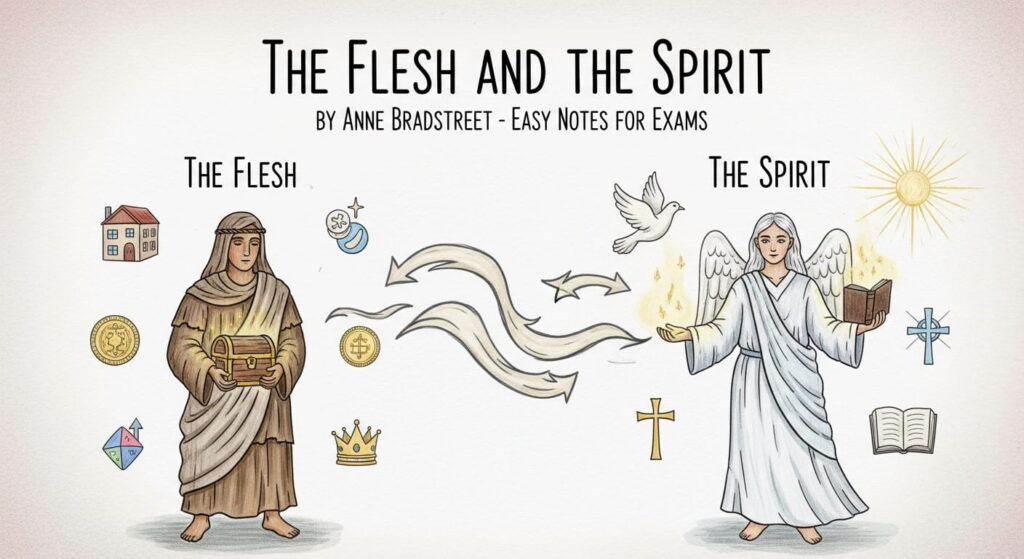
Reading this poem alongside The Flesh and the Spirit illuminates Bradstreet’s range. The Flesh and the Spirit explores the internal tension between worldly desire and spiritual faith. Furthermore, it operates within a deeply personal and theological register throughout. Consequently, it presents Bradstreet’s inward spiritual struggle with great emotional honesty. Additionally, this poem operates in a completely different and more public historical register. It engages with the external world of political achievement and historical legacy. Therefore, the contrast demonstrates Bradstreet’s remarkable tonal and thematic range. Moreover, both poems reflect her consistent concern with what constitutes true greatness. The Flesh and the Spirit argues that spiritual greatness surpasses worldly achievement. Furthermore, this poem suggests that Elizabeth achieved both worldly and spiritual greatness simultaneously. Additionally, both poems use their central subjects to make arguments about value and achievement. Consequently, they complement each other as explorations of different modes of human excellence. Furthermore, reading both reveals Bradstreet’s consistent philosophical seriousness. Therefore, In Honour of That High and Mighty Princess Queen Elizabeth gains additional depth when read alongside The Flesh and the Spirit.
12. Bradstreet’s Challenge to Male Critics
Bradstreet directly challenges male critics of female achievement in this poem. She does not merely defend women’s capacity but actively attacks male dismissiveness. Furthermore, she uses Elizabeth’s historical record as her unanswerable rhetorical weapon. Consequently, the poem adopts a more confrontational tone than many of her other works. Additionally, she implies that any man who doubts female capacity insults Elizabeth’s memory directly. Therefore, her challenge to male critics is both historically grounded and personally charged. Moreover, the rhetorical strategy is brilliantly effective and carefully constructed. She does not argue from emotion or personal complaint alone. Furthermore, she argues from historical facts that no honest reader can deny. Additionally, the confrontational tone reflects Bradstreet’s growing confidence as a mature poet. Consequently, In Honour of That High and Mighty Princess Queen Elizabeth represents her most assertive feminist statement. Furthermore, it demonstrates that she had moved beyond defensive apology. She no longer merely asked permission to write.
13. Language, Imagery, and Poetic Craft
Bradstreet employs powerful and precise language throughout this poem. The imagery draws from history, nature, classical mythology, and biblical tradition. Furthermore, she uses regal and ceremonial vocabulary appropriate to her royal subject. Consequently, the language mirrors the grandeur and dignity of Elizabeth’s reign. Additionally, military imagery celebrates the Armada’s defeat with genuine martial energy. The poem’s language becomes bold and triumphant in these historical passages. Therefore, the language adapts itself skillfully to different aspects of Elizabeth’s achievement. Moreover, classical mythological allusions reinforce Elizabeth’s legendary and almost divine status. Furthermore, Bradstreet compares Elizabeth favorably to figures from classical history and mythology. This classical reference demonstrates Bradstreet’s own scholarly learning and intellectual authority. Additionally, the poem uses nature imagery to suggest Elizabeth’s enduring historical legacy. Consequently, the language creates a rich and layered celebration of female achievement. Furthermore, Bradstreet’s poetic craft is at its most confident and controlled in this poem. Therefore, the language and imagery reflect genuine poetic mastery and intellectual ambition.
14. Elizabeth and Puritan Theology
The poem connects Elizabeth’s achievements to Puritan theological frameworks. Bradstreet understood Elizabeth’s reign through a providential theological lens. Furthermore, God’s blessing on Elizabeth explained her extraordinary political and military success. Consequently, theological and political arguments reinforce each other throughout the poem. Additionally, the Armada’s defeat was widely interpreted as a manifestation of divine providence in Protestant England. God had protected his chosen people and their queen from Catholic aggression. Therefore, Elizabeth’s victory carried deep theological as well as political significance. Moreover, Puritanism gave Bradstreet a framework for celebrating female achievement. If God chose to work through a woman monarch, female authority was divinely sanctioned. Furthermore, this theological argument was particularly powerful within Bradstreet’s Puritan context. Additionally, Providence overrode any human arguments against female capacity and authority. Consequently, Bradstreet used theology to reinforce her feminist historical argument. Furthermore, In Honour of That High and Mighty Princess Queen Elizabeth gains divine authority through this providential framework.
15. The Poem’s Place in American Literary History
This poem holds a genuinely significant place in early American literary history. It belongs to the founding moment of American literary culture. Furthermore, it demonstrates that early American writing engaged seriously with political and historical subjects. Consequently, American literature begins with genuine political and intellectual ambition. Additionally, the poem was one of the first explicitly feminist political poems in American literature. Therefore, it anticipates major currents of later American literary and political thought. Moreover, Bradstreet established an important precedent for later American women writers. She proved that political subjects were legitimate territory for female literary voices. Furthermore, later American women writers from Phillis Wheatley onward built on this precedent. Additionally, the poem’s engagement with English history reflects the colonial American situation. Bradstreet wrote as both an English subject and a colonial American voice simultaneously. Consequently, the poem occupies a fascinating position between two cultural worlds. Furthermore, it helped define what American literature could address and achieve. Therefore, In Honour of That High and Mighty Princess Queen Elizabeth is an essential document in the history of American literature and feminist literary tradition.
16. Elizabeth as Role Model for Colonial Women
Elizabeth I served as a powerful role model for colonial American women. She demonstrated that female capacity for achievement was historically proven. Furthermore, her example provided colonial women with an inspiring historical precedent. Consequently, Bradstreet’s celebration of Elizabeth was also an act of collective female empowerment. Additionally, colonial women faced severe restrictions on their public roles and intellectual expression. Elizabeth’s reign offered a spectacular counter-example to these restrictions. Therefore, the poem implicitly encouraged colonial women to claim their own capacities. Moreover, Elizabeth’s example was particularly powerful because it was historical fact. No one could dismiss Elizabeth’s achievements as mere imagination or wishful thinking. Furthermore, her forty-five-year reign stood as permanent and undeniable historical record. Additionally, Bradstreet clearly identified with Elizabeth’s intellectual and creative achievements personally. Consequently, the celebration of Elizabeth expressed both admiration and personal identification. Furthermore, the poem invited colonial women readers to similarly identify with Elizabeth’s greatness.
17. Comparison With Male-Authored Elegies
Bradstreet’s poem invites comparison with male-authored elegies of the same period. Male poets frequently wrote elegies celebrating monarchs and political figures. Furthermore, these were considered legitimate and prestigious poetic exercises. Consequently, Bradstreet’s choice to write in this tradition was itself significant. Additionally, she entered a masculine poetic tradition and performed it with genuine skill. Therefore, the poem asserts female capacity to engage with the most prestigious poetic genres. Moreover, male elegies of the period often celebrated male monarchs and warriors. Bradstreet deliberately chose a female subject for this prestigious form. Furthermore, by choosing Elizabeth she asserted the worthiness of female achievement as elegiac subject. Additionally, she performed the elegiac tradition with sufficient skill to rival male practitioners. Consequently, the poem argues for female literary equality through demonstration. Furthermore, this strategy mirrors her broader feminist approach throughout her career. She showed rather than merely argued for female literary competence. Therefore, by successfully performing a prestigious masculine poetic genre, In Honour of That High and Mighty Princess Queen Elizabeth constituted a powerful and implicit feminist argument.
18. The Poem’s Tone: Confidence and Celebration
The poem’s tone is one of its most distinctive and significant qualities. Bradstreet writes with unusual confidence and celebratory energy throughout. Furthermore, the tone is far more assertive than many of her other poems. Consequently, the poem feels like a genuine departure in her feminist rhetorical approach. Additionally, the celebratory tone serves the feminist argument with particular effectiveness. Celebration is more persuasive than complaint or defensive apology. Therefore, Bradstreet’s positive tone makes the feminist argument more accessible and compelling. Moreover, the tone of confident celebration mirrors Elizabeth’s own legendary self-presentation. Elizabeth herself famously projected confidence, authority, and magnificent self-assurance. Furthermore, by adopting a similarly confident tone Bradstreet implicitly claims similar authority. Additionally, the tone shifts subtly when challenging male critics directly. It becomes sharper, more combative, and more rhetorically pointed. Consequently, the tonal range reflects Bradstreet’s sophisticated control of her rhetorical situation. Furthermore, the predominant celebratory tone prevents the poem from becoming merely polemical.
19. Elizabeth’s Political Achievements
The poem surveys Elizabeth’s political achievements with genuine admiration and precision. Bradstreet celebrates Elizabeth’s ability to maintain political stability for forty-five years. Furthermore, this achievement was remarkable given the religious and political conflicts of her era. Consequently, Elizabeth’s political skill emerges as one of her greatest accomplishments. Additionally, she navigated the complex rivalries of European political life with extraordinary intelligence. Therefore, her political achievements demonstrated the highest form of human intellectual and strategic capacity. Moreover, Bradstreet presents Elizabeth’s political achievements as fundamentally equal to any male monarch’s. Furthermore, she implies that Elizabeth’s achievements surpassed most male rulers in quality and duration. Additionally, political achievement was the domain most firmly reserved for men in Bradstreet’s world. Consequently, Elizabeth’s political success was the most powerful argument available for female equality. Furthermore, Bradstreet deploys this argument with full awareness of its rhetorical force. Therefore, In Honour of That High and Mighty Princess Queen Elizabeth uses Elizabeth’s political record as its most fundamental and unanswerable feminist argument.
20. The Poem and Female Literary Tradition
The poem participates in and contributes to a female literary tradition. Bradstreet was not the only woman writing about powerful women in this period. Furthermore, women writers across Europe celebrated female achievement in various ways. Consequently, Bradstreet’s poem joins a broader tradition of female literary self-assertion. Additionally, the tradition of praising Queen Elizabeth was well established in English literature. Male poets from Spenser to Shakespeare celebrated Elizabeth’s greatness consistently. Therefore, Bradstreet entered an existing literary tradition from a unique female perspective. Moreover, her female perspective gave the celebration a different and deeper significance. Furthermore, she was not merely a male subject praising his female queen. She was a female subject claiming solidarity with female greatness across history. Additionally, this solidarity gave the poem its particular emotional and political resonance. Consequently, the poem created a bond between the colonial woman poet and the great queen. Furthermore, this bond transcended the boundaries of time, class, and geography.
21. Legacy of the Poem in Feminist Literary Criticism
Feminist literary critics have given this poem increasing and sustained attention. Early critics sometimes overlooked it in favor of Bradstreet’s more personal poems. Furthermore, they occasionally read her self-deprecating poems as evidence of genuine submission. Consequently, the more assertive feminist voice of this poem was sometimes undervalued. However, modern feminist scholarship has thoroughly reassessed this limited perspective. Additionally, critics now recognize the poem as one of Bradstreet’s most significant feminist statements. Therefore, its place in American literary and feminist history has been firmly established. Moreover, the poem demonstrates that Bradstreet possessed a range of feminist rhetorical strategies. She could be apologetic, personal, and historically assertive depending on her rhetorical needs. Furthermore, this range reveals a sophisticated and self-aware feminist literary intelligence. Additionally, the poem connects Bradstreet to broader traditions of women’s political writing. Consequently, feminist critics place it within a long history of women claiming political voice. Furthermore, the poem continues to inspire feminist literary scholars and students. Therefore, In Honour of That High and Mighty Princess Queen Elizabeth holds a permanent and important place in feminist literary critical tradition.
22. The Poem and Bradstreet’s Biographical Journey
The poem reflects a significant moment in Bradstreet’s biographical and literary journey. She wrote it as a mature and experienced poet with established literary credentials. Furthermore, she had already published The Tenth Muse and developed her literary voice substantially. Consequently, the poem reflects a growing confidence in her own literary and intellectual authority. Additionally, the unauthorized publication of her poems had forced her to confront her own public identity. Therefore, she had already grappled with the complexities of female authorship and public exposure. Moreover, writing about Elizabeth allowed her to reclaim and strengthen her literary identity. Furthermore, celebrating the greatest female achiever in English history was an act of personal empowerment. Additionally, the poem reflects her deepening engagement with feminist questions across her career. Consequently, it represents the culmination of one strand of her literary development. Furthermore, the poem shows how her feminist thinking had evolved from personal apology to historical assertion.
23. The Poem’s Relevance to Modern Readers
The poem speaks with genuine relevance to modern readers and students. Questions of female leadership, political authority, and gender equality remain urgently contemporary. Furthermore, debates about women’s capacity for political leadership continue in many contexts today. Consequently, Bradstreet’s seventeenth-century argument resonates powerfully with modern feminist concerns. Additionally, the poem’s use of historical example as feminist argument remains rhetorically effective. Modern feminists similarly point to women’s historical achievements as evidence of capacity. Therefore, Bradstreet’s rhetorical strategy anticipates contemporary feminist argumentative practices. Moreover, the poem’s celebration of Elizabeth invites modern readers to reflect on female political leadership. Furthermore, Elizabeth’s legacy remains relevant to modern discussions of gender and power. Additionally, the poem’s confident and celebratory tone offers a model of feminist assertiveness. Consequently, modern readers find in Bradstreet a historical ally. Furthermore, In Honour of That High and Mighty Princess Queen Elizabeth demonstrates that feminist literary voices have deep American colonial roots.
24. Critical Reception and Scholarly Perspectives
Scholars have given this poem increasing and sustained critical attention. Early scholarship sometimes focused primarily on Bradstreet’s more personal and domestic poems. Furthermore, the political and historical dimensions of this poem were occasionally undervalued. Consequently, it received less attention than poems like Contemplations or The Prologue initially. However, modern feminist and political scholarship has significantly reassessed this situation. Additionally, critics now recognize the poem as a major statement of Bradstreet’s feminist vision. Therefore, In Honour of That High and Mighty Princess Queen Elizabeth occupies a central place in current Bradstreet scholarship. Moreover, new historicist critics read it within its specific colonial political context. They examine how Bradstreet navigated the relationship between English history and colonial American identity. Furthermore, comparative studies place the poem within broader traditions of women’s political writing. Additionally, scholars explore its relationship to male-authored elegies and political verse of the period. Consequently, the poem attracts genuinely interdisciplinary scholarly attention across multiple fields.
25. Teaching and Studying the Poem
This poem rewards careful and sustained study in any educational context. Students gain enormously from close engagement with its language and arguments. Furthermore, it introduces early American feminist literature in a vivid and historically grounded way. Consequently, students understand the Puritan political world more richly through the poem. Additionally, the poem raises genuinely important questions about gender and political authority. These questions provoke authentic personal reflection and productive intellectual discussion. Therefore, the poem works beautifully as a starting point for feminist literary analysis. Moreover, the poem’s historical dimensions offer rich interdisciplinary learning opportunities. Teachers can connect it productively to Tudor history, women’s history, and political theory. Furthermore, the poem’s classical allusions make it excellent for exploring Renaissance literary traditions. Additionally, comparing it to The Prologue deepens understanding of Bradstreet’s feminist strategy. Consequently, the two poems together make an ideal classroom unit for feminist literary study. Furthermore, the poem connects naturally to discussions of women’s political representation today. For further resources visit englishlitnotes.com and americanlit.englishlitnotes.com.
26. The Poem’s Classical and Renaissance Sources
The poem draws richly from classical and Renaissance literary traditions. Bradstreet was widely read in classical history, mythology, and literature. Furthermore, she drew on this reading to enrich her celebration of Elizabeth. Consequently, the poem places Elizabeth within a grand classical tradition of celebrated women. Additionally, classical references to powerful women like Penthesilea and Zenobia appear throughout. These classical warrior women provide historical precedents for female courage and authority. Therefore, the classical framework reinforces the feminist argument with ancient authority. Moreover, Renaissance literature provided models for celebrating monarchs in elevated verse. Spenser’s Faerie Queene celebrated Elizabeth as the ideal of female sovereignty. Furthermore, Bradstreet drew on this tradition while adapting it to her own colonial context. Additionally, the Renaissance tradition of the learned woman provided further intellectual framework. Consequently, Bradstreet connected her celebration to a rich European intellectual tradition. Furthermore, the classical and Renaissance sources demonstrate her own extensive scholarly learning.
27. Elizabeth’s Cultural Patronage
The poem celebrates Elizabeth’s extraordinary cultural patronage and artistic legacy. Elizabeth supported poets, dramatists, musicians, and scholars with genuine enthusiasm. Furthermore, her court became the center of one of England’s greatest cultural flowerings. Consequently, the Elizabethan age produced literary achievements that transformed English culture permanently. Additionally, Shakespeare, Marlowe, Spenser, and Sidney all flourished under her cultural patronage. Therefore, Elizabeth’s cultural legacy was as great as her political and military achievements. Moreover, Bradstreet’s celebration of Elizabeth’s cultural patronage carries personal resonance. Furthermore, as a poet herself she recognized and deeply valued the importance of royal cultural support. Additionally, Elizabeth’s support for literature implicitly validated the literary arts as worthy of serious attention. Consequently, celebrating Elizabeth’s cultural legacy was also a celebration of poetry itself. Furthermore, the cultural dimension of the poem connects to Bradstreet’s identity as a literary creator. Therefore, by celebrating Elizabeth’s patronage of the arts Bradstreet simultaneously celebrated her own literary vocation.
28. The Poem’s Enduring Legacy
The legacy of this poem extends across four centuries of literary and feminist history. In Honour of That High and Mighty Princess Queen Elizabeth helped establish feminist political poetry as a legitimate American literary mode. Furthermore, it proved that women’s voices could engage seriously with the greatest public and historical subjects. Consequently, later American women writers inherited a richer and more politically confident literary tradition. Additionally, the poem’s feminist strategy of historical argument remains genuinely influential. Modern feminist scholars and activists continue to use historical example as evidence of female capacity. Therefore, Bradstreet’s rhetorical strategy anticipates contemporary feminist practice. Moreover, the poem’s celebration of female political achievement remains culturally resonant. Women in political life today continue to draw on the example of historical female leaders. Furthermore, Elizabeth I herself remains a powerful feminist symbol in contemporary culture. Additionally, the poem demonstrates that American feminist literary tradition has deep colonial roots.
Conclusion
In Honour of That High and Mighty Princess Queen Elizabeth stands as one of Bradstreet’s greatest and most politically significant achievements. It combines historical celebration with genuine feminist argument and remarkable poetic artistry. Furthermore, it speaks powerful truths about female achievement, political authority, and intellectual capacity. Consequently, it has resonated with readers and scholars across four centuries without losing its force. Additionally, the poem reflects Bradstreet’s extraordinary courage as a woman writer in a deeply restrictive world. She used history’s greatest female monarch to argue for all women’s intellectual and creative equality. Therefore, the poem commands genuine intellectual admiration and lasting cultural respect. Moreover, it demonstrates what political poetry achieves at its most historically grounded and rhetorically confident. A poem rooted in historical fact can carry the weight of an entire feminist argument. Furthermore, it can speak to one specific colonial moment and to all of human history simultaneously.
Discover more from Welcome to My Site of American Literature
Subscribe to get the latest posts sent to your email.