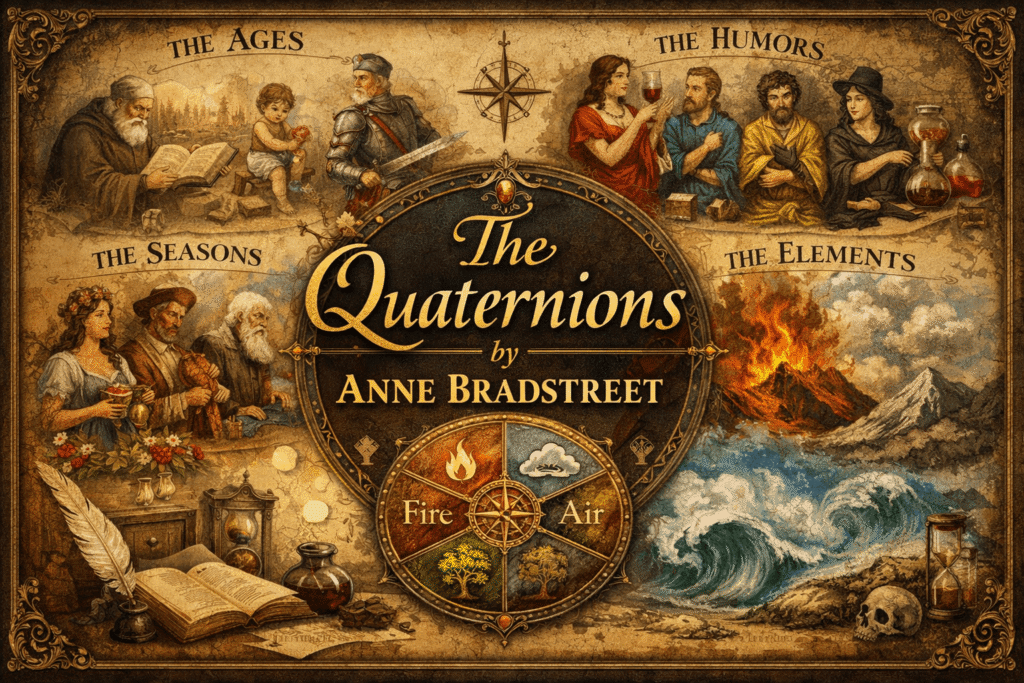
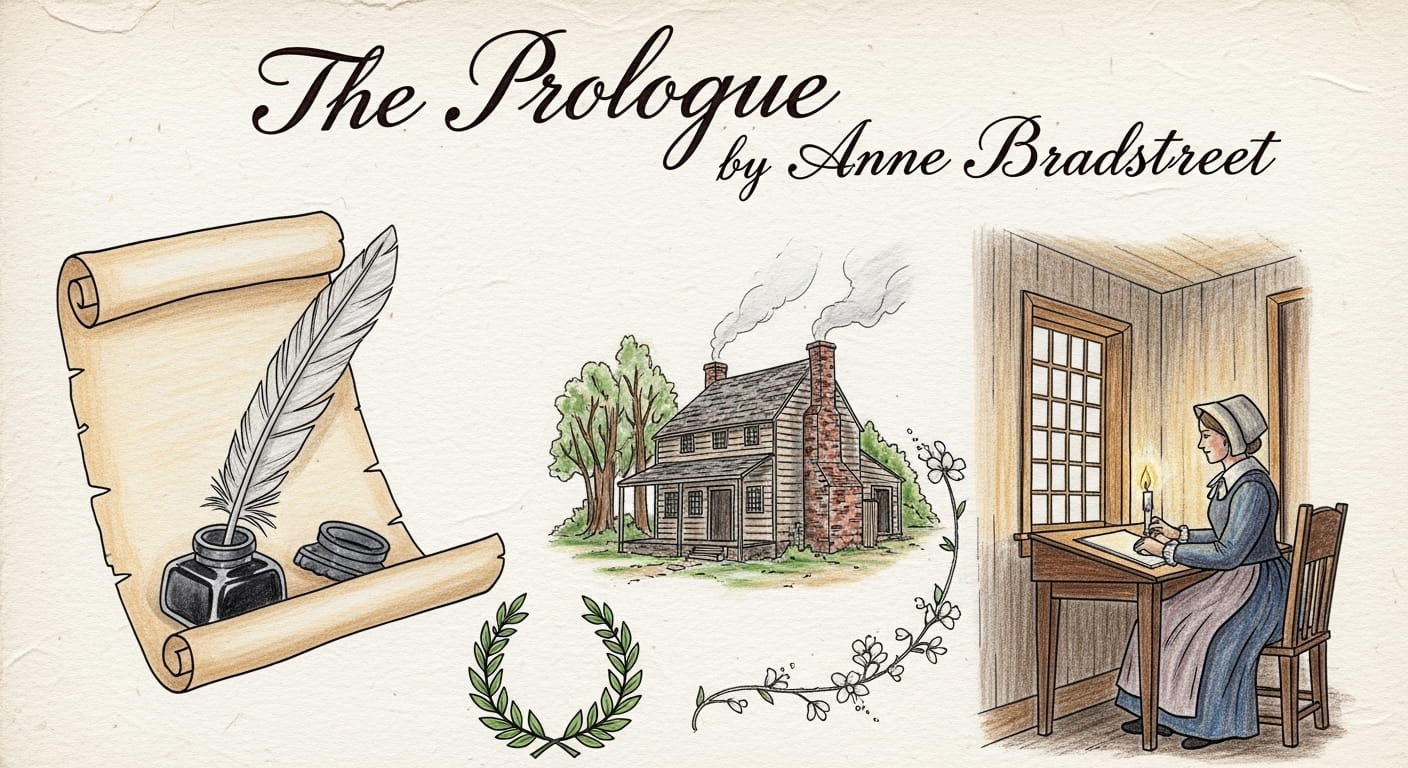
Introduction
The poem stands as a monumental pillar in early American literature. It serves as a brave bridge between tradition and the new world. Anne Bradstreet wrote this piece during the restrictive seventeenth century. She faced a society that often silenced the female voice. However, she used her pen to claim a vital space. The work explores the complex identity of a woman artist. She expertly balances deep humility with a very sharp social wit. Her verses challenge the rigid expectations of her Puritan peers. This text remains a key focus for modern feminist scholars. It highlights the poet’s internal and external struggles. The Theme of The Prologue is the quest for intellectual respect. She skillfully navigates the tensions of her era through verse. Every stanza reveals a mind that refuses to be small. She demonstrates that gender roles cannot confine creativity. Her legacy continues to inspire those who seek their truth. The poem is both a humble plea and a manifesto. It invites us to witness the birth of American poesy.
Summary of The Prologue by Anne Bradstreet: https://americanlit.englishlitnotes.com/the-prologue-by-anne-bradstreet/
1. Obscure
The poet begins by discussing her humble, obscure origins. She does not seek to rival the great epic poets. Instead, her focus remains on private and domestic themes. However, this modesty is often seen as a clever mask. It allows her to speak without causing immediate offense. Many readers find her tone to be quite deceptive. She claims her lines are too low for grand topics. Yet, her skill proves that she is far from simple. Her voice rises from the shadows of her time. The Theme of The Prologue centers on this hidden strength. It highlights the struggle of the female intellectual voice. Society expected her to remain silent and largely invisible. She chose to write despite these heavy social pressures. Every word serves to bridge the gap of understanding. Her obscure status did not limit her creative vision. She built a legacy that still resonates today. Furthermore, her obscurity provides a shield against the church. It allows for a subtle subversion of patriarchal laws. Thus, her “obscure” status is a tactical choice of art.
2. Needle
Puritan society expected women to master the sewing needle. Domestic labor was the only acceptable path for them. Bradstreet acknowledges this rigid expectation in her famous poem. Critics claimed her hand should hold a needle only. They felt the pen was a tool for men. She uses this tension to highlight a double standard. The Theme of The Prologue explores this clash of tools. Sewing represents the physical labor required of her gender. Writing represents the intellectual freedom she deeply craves. She mocks the idea that women cannot do both. Her poem is a stitch in the fabric of history. It mends the gap between craft and high art. She proves that a mind cannot be confined. Her needle may work, but her mind wanders far. This duality defines her experience as a colonial woman. Consequently, the needle becomes a symbol of female bondage. Yet, she uses it to weave a complex narrative. Therefore, the domestic becomes a site of silent rebellion.
3. Muse
Bradstreet addresses her “broken, blemish’d Muse” with great irony. She suggests her inspiration is somehow flawed or weak. This was a common trope in early modern poetry. By doing so, she avoids the charge of pride. However, her Muse is actually quite sharp and capable. She invokes the classical tradition to prove her knowledge. The Theme of The Prologue involves reclaiming the creative spirit. Male poets often looked to female Muses for help. Bradstreet points out the irony of this specific tradition. Men praise the Muse but often dismiss the woman. She seeks a path that honors her own internal drive. Her Muse is not broken, despite her humble claims. It is a powerful force that drives her pen forward. She finds beauty in what others might call defects. Additionally, she challenges the gender of divine inspiration itself. Her Muse is a mirror of her own resilience. Thus, the Muse represents the survival of the female soul.
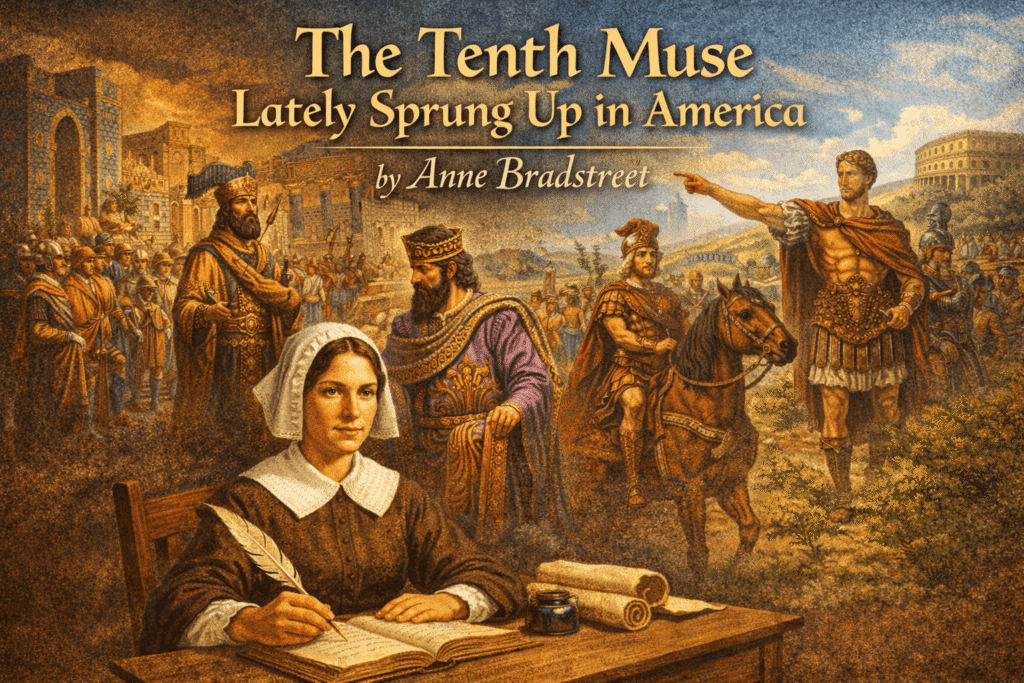
The Tenth Muse Lately Sprung Up in America by Anne Bradstreet: https://americanlit.englishlitnotes.com/the-tenth-muse-lately-sprung-up-in-america-1650/
4. Defect
The author speaks often of her own perceived natural defect. She refers to her “unrefined” and “simple” poetic craft. This language reflects the harsh views of her critics. They believed women lacked the brain power for art. Bradstreet adopts their language to turn it against them. The Theme of The Prologue uses this “defect” as a weapon. By admitting “weakness,” she gains the freedom to speak. It is a brilliant display of rhetorical skill and wit. She knows her work is strong and technically sound. The supposed defect lies in the eyes of the viewer. Her poetry shines despite the labels placed upon her. She challenges the idea of inherent female inferiority. Her verses are structured with great care and precision. She proves that “defects” are merely social constructs. Consequently, the defect becomes a source of creative strength. Therefore, she transforms a social insult into an artistic badge. She builds a monument out of her supposed flaws.
5. Poesy
Poesy is the high art that Bradstreet deeply admires. She mentions the “sweet tongues” of the great Greek poets. She feels she cannot reach those heights of expression. Yet, her poem itself is a masterclass in poesy. The Theme of The Prologue celebrates the power of verse. It shows how language can challenge a rigid world. She uses rhyme and meter to showcase her talent. Her poesy is a bridge between two different worlds. It connects the wild colony to the old traditions. She seeks a small place among the famous bards. Her work is a testament to the enduring human spirit. She loves the craft more than she fears the critics. Every line is a heartbeat of her creative soul. Poesy becomes her way of defining her own life. Furthermore, she uses poesy to argue for female education. It is an intellectual pursuit that demands deep focus. Thus, poesy serves as a vehicle for her liberation.
6. Mean
The word “mean” refers to things that are humble. Bradstreet calls her own lines “mean” and very low. This is part of her strategy of self-deprecation. She knows that pride is a sin in her community. Therefore, she presents herself as a very simple writer. The Theme of The Prologue hides behind this mean exterior. It allows her to critique men without being stopped. Her “mean” pen actually writes with great sophisticated grace. She mocks the critics who take her words literally. Her intellect is far from mean or lowly in nature. She possesses a wealth of thought and deep feeling. The word “mean” becomes a shield for her ambition. She uses it to navigate a very dangerous landscape. Her true power lies in this subtle use of irony. Consequently, “mean” is a mask for her hidden genius. However, the mask is transparent to the careful reader. She is far more than a “mean” poetess.
7. Envy
She mentions that she does not feel any envy. She claims she does not want the poets’ crowns. This statement is likely a form of poetic defense. It protects her from the wrath of male peers. The Theme of The Prologue addresses the fear of competition. Men feared that women might actually surpass their work. Bradstreet insists she only wants a very small recognition. She does not seek to steal their glorious “bays.” However, her talent naturally creates a sense of rivalry. Envy is a shadow that follows any successful artist. She recognizes the toxic nature of the literary world. Her goal is to express herself, not to win. She writes for the love of the written word. This lack of envy makes her voice more pure. Furthermore, she uses this lack of envy as proof. She proves that women are not naturally spiteful beings. Therefore, her art is free from petty social games.
8. Quill
The quill represents the physical act of writing poetry. It was a tool usually reserved for the educated. In her time, education was mostly for men only. Bradstreet holding a quill was a radical political act. The Theme of The Prologue centers on the quill’s power. It is the instrument she uses to claim space. Critics suggested her hand was not fit for it. She proves them wrong with every single stanza written. The quill is mightier than the domestic sewing needle. It records her thoughts for future generations to read. She uses it to carve out a female identity. Her quill is sharp, precise, and very deeply felt. It is the bridge between her mind and paper. She treats it with both reverence and great skill. Consequently, the quill becomes an extension of her soul. It writes a history that men tried to erase. Thus, the quill is her weapon against social silence.
To read Shakespeare and His Achievements, follow the link: https://englishlitnotes.com/2025/06/15/shakespeare-as-a-renaissance-writer/
9. Grudge
Bradstreet speaks of the “grudge” men hold against women. They believe that women should not write at all. Any success by a woman is seen as luck. They claim she must have stolen her best lines. The Theme of The Prologue exposes this deep-seated social grudge. It shows the unfair barriers placed in her way. She addresses the critics directly with a calm voice. She asks why they are so offended by her. Their grudge stems from a fear of losing power. She does not back down from their harsh words. Instead, she uses their anger to fuel her art. The poem becomes a reply to their many grievances. She handles their grudge with a touch of wit. Her work outlives the spite of her many critics. Therefore, the grudge reveals more about the critic’s fear. It shows the fragility of the male literary ego. She remains unmoved by their collective social bitter scorn.
10. Laurel
The laurel crown is the ultimate symbol of victory. It was given to the best poets in Greece. Bradstreet knows she will never wear the gold laurel. She says it is reserved for the male “prodigies.” The Theme of The Prologue negotiates for a lesser prize. She asks for a simple “thyme or parsley wreath.” This request is both humble and very biting. It suggests that her work is still worth something. She does not need the grandest symbols of fame. A small token of respect is all she asks. The laurel represents a world she cannot fully enter. Yet, she creates her own world through her poetry. Her “parsley wreath” becomes a badge of true honor. She finds value in her own unique creative path. Consequently, she redefines what it means to be successful. Therefore, the laurel is not the only valid reward. Her green parsley wreath holds its own quiet magic.
11. Unrefined
She calls her own work “unrefined” and very raw. She says her lines lack the shine of gold. This fits her image as a simple colonial mother. It keeps her safe from those who hate pride. The Theme of The Prologue questions what “refined” truly means. Is it only the work of men that shines? She proves that her “unrefined” lines have deep value. Her structure is tight and her rhymes are perfect. There is a hidden beauty in her plain style. She embraces her status as an “unrefined” colonial voice. It gives her a unique perspective on the world. She does not need the polish of the elite. Her truth is found in the simple and direct. Her work has a lasting and natural strength. Furthermore, she uses “unrefined” to mock the critics’ standards. Thus, the raw ore of her mind is gold. She strikes a vein of truth in her art.
12. Art
Art is the central pursuit of Bradstreet’s secret life. She values the “art” of the great ancient masters. She feels her own art is “ill-form’d” and weak. This is another example of her clever rhetorical style. The Theme of The Prologue explores the nature of art. It asks who has the right to create it. She argues that art belongs to the mind, regardless. Her poem is a work of high literary art. It uses complex metaphors and a steady, rhythmic beat. She understands the rules of the craft very well. She breaks the rules by simply being a woman. Art is her escape from the chores of life. It is her way of speaking to the future. Her art is a flame that burns very brightly. Consequently, she places herself within the lineage of bards. Therefore, her art is a bridge across the ocean. It connects her small home to the wide world.
13. Female
Being a female poet in 1650 was very difficult. The word “female” carried many negative social connotations then. Women were thought to be intellectually inferior to men. Bradstreet confronts these labels with a very steady hand. The Theme of The Prologue focuses on the female experience. It highlights the struggle for basic intellectual respect. She uses her gender as a point of departure. She does not try to write exactly like men. Her voice is distinctly and proudly that of a woman. She demands a “small acknowledgment” for her gender’s wit. Her work paved the way for many future writers. She turned “female” into a word of great strength. Her legacy is a gift to all women writers. Thus, she creates a space where women can exist. Furthermore, she proves that femininity is not a poetic weakness. Therefore, her gender is the core of her art.
14. Wit
Wit is the sharpness of mind that Bradstreet possesses. She acknowledges that men claim all the “wit” today. They believe women are “void” of any real reason. She uses her own wit to disprove this idea. The Theme of The Prologue is a display of wit. She crafts a poem that is smarter than critics. Her irony is a sign of a high intellect. She plays with words to expose their many biases. Wit is her defense against a very cold world. It allows her to speak truths that are dangerous. She proves that a woman’s wit is quite formidable. Her poem is a brilliant game of logic and soul. She wins the game through her quiet, sharp mind. Her wit is a light in a dark time. Consequently, she mocks the very men who dismiss her. Therefore, her wit is her most sharp and effective tool. It cuts through the thickest wall of social bias.
15. Nature
Nature is often contrasted with the “Art” of poetry. Bradstreet suggests her work is a product of nature. This implies it is spontaneous and perhaps less crafted. The Theme of The Prologue links nature to the feminine. Men are often linked to the “Art” of civilization. However, she shows that her nature is very disciplined. She uses natural metaphors like “ore” and “thyme” often. These images ground her work in the real world. Nature provides the raw material for her beautiful verses. She sees herself as a natural part of history. Her voice is as inevitable as the changing seasons. She finds harmony between her nature and her craft. Nature is her teacher and her greatest source of life. Additionally, she argues that nature made women capable of art. Thus, the “nature” of her mind is quite vast. She blooms in a world that tries to freeze.
16. Broken
The poet describes her Muse as being “broken” often. This refers to the limitations she feels she has. It also reflects the “broken” status of women’s rights. She feels her creative voice is hindered by society. The Theme of The Prologue deals with these broken pieces. She takes the fragments and makes something very whole. Her “broken” lines are actually very strong and rhythmic. The word “broken” is a nod to her humility. It serves as a shield against the “fluent” men. She claims her instrument is not tuned quite right. Yet, the music she makes is hauntingly and clear. She finds power in acknowledging her own many struggles. A broken voice can still sing a beautiful song. Consequently, the “broken” Muse is a mirror of the world. Therefore, she finds a new rhythm in the cracks. Her art survives the breaking of her social status.
17. Thyme
Bradstreet asks for a wreath of “thyme or parsley.” These are common kitchen herbs used in daily cooking. They represent the domestic sphere where she is “kept.” The Theme of The Prologue revalues these humble plants. She suggests they are enough of a reward for her. This is a sharp contrast to the elite laurel. It shows her pride in her own domestic reality. She does not need to leave home to be great. Thyme is a symbol of her quiet, steady growth. It represents the “female” space she has mastered well. Her “thyme” wreath is a crown of her own. She finds dignity in the small and the local. Her poetry smells of the earth and the home. Furthermore, she claims the kitchen as a place of thought. Thus, thyme is a symbol of her secret power. She seasons her world with the flavor of truth.
18. Critics
The “critics” are the antagonistic force in her life. They are the men who say her pen “offends.” They believe her work is either stolen or lucky. Bradstreet addresses these critics with a very calm irony. The Theme of The Prologue is a response to them. She does not beg for their approval or love. She simply asks them to stop being so mean. Her words are a mirror for their own prejudice. She knows their names will be forgotten in time. Her work, however, will continue to be read widely. The critics represent the walls that she must climb. She climbs them with grace and a sharp quill. She turns their criticism into a source of art. Consequently, she renders the critics powerless through her silence. Therefore, her art is the ultimate revenge on them. She laughs last through the power of her lines.
19. Usurp
To “usurp” means to take a place unfairly. Critics feared women would usurp the place of men. They thought poetry was a “masculine” throne to hold. Bradstreet promises she does not want to usurp them. The Theme of The Prologue navigates this fear of loss. She assures them their “precedence” is safe for now. This is a very strategic move on her part. It lowers their guard so she can keep writing. She does not want their throne; she wants her own. She seeks a parallel space for her female voice. By denying the “usurp,” she gains the right to be. It is a brilliant move in a dangerous game. She knows how to navigate the halls of power. Thus, she carves out a kingdom without any blood. Furthermore, she proves that art is not a zero-sum game. Therefore, her voice does not take from the men.
20. Precedence
Men claimed “precedence” in all things during the 1600s. They were the first in art, law, and church. Bradstreet acknowledges this social hierarchy in her many verses. She says men have the “precedence” in all things. The Theme of The Prologue accepts this to survive. However, the poem itself challenges the very idea of it. If her work is good, why does precedence matter? She plays the part of the submissive colonial wife. Underneath, she is a revolutionary and a thinker. She grants them their “precedence” with a small wink. It is a small price to pay for her voice. She knows that talent has no real gendered rank. Her work stands on its own merit and truth. Consequently, she honors the past while building the future. Therefore, precedence is only a matter of timing and luck. Her voice is timeless and defies any simple rank.
21. Bay
The “bay” refers to the laurel tree’s green leaves. It is the prize for the most “fluent” poets. Bradstreet says she will not “case” or seek it. She leaves the “bays” for the “prodigies” of men. The Theme of The Prologue settles for a different goal. She creates a new kind of literary achievement here. The “bay” is a symbol of a male tradition. She is starting a new tradition for her gender. She does not need their specific symbols of success. Her “parsley” is just as green and very alive. The “bay” represents an old world she is leaving. She is focused on the new world she builds. Her poetry is her own version of the bay. Furthermore, she mocks the vanity of the laurel crown. Thus, she finds her reward in the act itself. Therefore, the “bay” is not the measure of art.
22. Service
She mentions that she does not seek “service” or fame. She claims she writes for her own small pleasure. This is a way to avoid appearing too ambitious. Ambition was seen as a major sin for women. The Theme of The Prologue is about the joy of writing. It is a service to her own creative soul. She does not write to serve the male ego. She writes to document her own life and thoughts. Her “service” is to the truth of her experience. She finds a way to be both humble and bold. Her work serves as a light for future generations. She is a pioneer who serves the cause of art. Every line is a service to the human spirit. Consequently, her service is far more noble than fame. Therefore, she finds peace in her private artistic duty. Her work is a gift to those who follow.
23. Ore
Bradstreet compares her poetic skill to “unrefined” metal ore. She says it lacks the “luster” of high-quality gold. This metaphor suggests that her talent is very raw. The Theme of The Prologue sees potential in this “ore.” She is digging for truth in a new land. Her work is the foundation of a new literature. It may not be “gold” yet, but it’s real. She values the substance over the mere surface shine. Her “ore” is heavy with meaning and deep thought. She is a miner of the human heart and mind. She does not need the polish of the elite. Her raw talent is more than enough for us. She finds wealth in her own simple, direct words. Furthermore, she suggests that refining takes time and effort. Thus, the “ore” of her soul is very rich. Therefore, she possesses a wealth that critics cannot see.
24. Sweet
The word “sweet” is used to describe great poetry. She mentions the “sweet tongues” of the famous Greeks. She feels her own lines are “harsh” and “low.” The Theme of The Prologue seeks a bit of sweetness. She wants her work to be “accepted” by readers. However, her sweetness is often mixed with sharp wit. She uses “sweet” words to deliver a very strong message. Her poem is a balance of sugar and sharp salt. She knows how to please while also making points. The “sweetness” of her meter makes her ideas accessible. She proves that she can be both kind and clever. Her voice has a lasting and very sweet resonance. Consequently, she proves that sweetness is a powerful rhetorical tool. Therefore, she catches the reader with a gentle, soft tone. Then, she reveals the deep truth underneath the surface.
25. Fluent
Men are described as “fluent” and “prodigious” in their art. They have the education to speak with great ease. Bradstreet claims she is not “fluent” in that way. The Theme of The Prologue highlights her different kind of fluency. She is fluent in the language of the heart. She speaks clearly about the reality of her own life. Her lack of “fluency” is a choice of style. She prefers the “plain style” of the Puritan world. It is a direct and very honest way to write. She proves that truth does not need fancy words. Her “unrefined” lines are more powerful than their “gold.” She is fluent in the art of being herself. This is the greatest fluency of all time. Furthermore, she uses her lack of fluency to listen. Thus, she hears the music of the natural world. Therefore, her silence is more fluent than their noise.
Conclusion
In conclusion, Bradstreet creates a masterful work of social protest. She uses humility to mask her deep literary ambition. The poem remains a vital piece of the American canon. It speaks to the struggle for voice and agency. She successfully navigated the dangers of her religious time. Her wit allowed her to speak the plain truth. She proved that the female mind is a treasure. The Theme of The Prologue continues to inspire new artists. It reminds us that art knows no gendered bounds. She built a bridge for all women to cross. Her words are as sharp as they were then. We must honor the courage of her creative spirit. She turned her “broken” Muse into a lasting legacy. Her parsley wreath shines brighter than any golden laurel. Thus, she is the mother of American poetry indeed. Therefore, her work will be studied for many years. She remains a beacon of light in literary history.
Discover more from Welcome to My Site of American Literature
Subscribe to get the latest posts sent to your email.